




Triangle pattern trading happens when prices move sideways between two trendlines and then break out in the direction of the previous trend. Every triangle is made up of four main shapes: symmetrical, ascending, descending, and expanding. When prices break above or below these important levels, a trading strategy is put into action.
When you want to predict big price changes, triangle pattern trading is one of the most exciting tools you can use. Understanding how to read the triangle pattern is essential if you want to improve your trading. This is because it often shows up before big breakouts. Because you know how a triangle trading strategy works, especially in the Elliott Wave patterns, you can get ahead of the rest of the traders.
Triangle Pattern Trading Strategy
So, what does triangle pattern trading really mean?
When a price stays between two trendlines that are coming together, making a shape that is either getting smaller or bigger, you have a triangle pattern. In a triangle, you wait for the price to narrow and then break out of consolidation. This pattern usually shows up when people aren’t sure what to do. Once the price breaks out of the triangle, it keeps going with strong momentum.
When trading with Elliott Wave’s triangle pattern, the triangle usually shows up during corrective phases, specifically in ABCDE correction structures, which are also called wave B, wave X, or wave 4. This is one reason why trading with triangle patterns is also known as trading in correction.
Usually, you’ll trade these things:
- Symmetrical Triangle
- Ascending Triangle
- Descending Triangle
- Expanding Triangle
You need to know that a triangle doesn’t mean that the trend is changing. Instead, it usually means to keep going. When the triangle is over, the price usually keeps going in the same direction as the last trend. Like flag pattern trading, triangle trading is a strong way to keep going when things get tough.
In Elliott Wave terms:
- A triangle usually shows up in Wave 4, Wave B, or Wave X.
- Wave 5 starts after the triangle (often when Wave E ends).
- This makes it perfect for trading the Wave C strategy or the Wave 5 breakout strategy.
How to Draw a Triangle Pattern in Trading?
If you know where to look, it’s easy to make a triangle pattern.

How to do it:
Identify a price change that has highs and lows and moves in a straight line.
- Draw a trendline connecting the highs (A to C to E).
- Connect the lows (B to D) with another trendline.
- If the lines come together, the triangle gets smaller.
- If the lines diverge, you have an expanding triangle.
- Label the waves as A, B, C, D, and E (ABCDE correction).
A triangle pattern tells you to enter based on the breakout direction when the price breaks above or below Wave D’s high or low.
Triangle Pattern Trading Chart
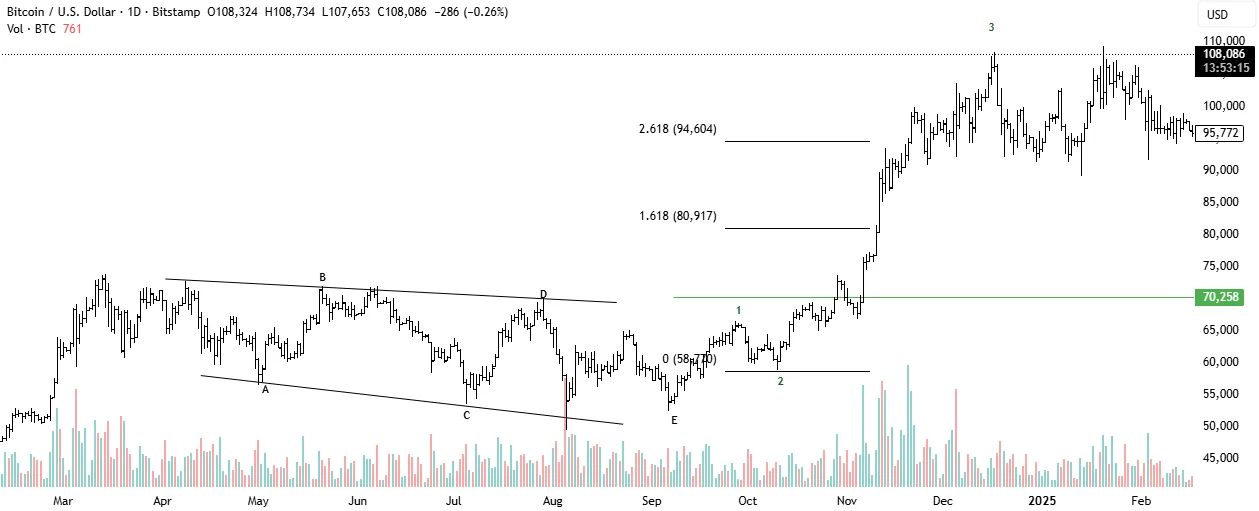
Let’s look at a strong example of a triangle pattern in real life from the BTCUSD daily chart, March–September 2024 (chart above).
It looked like BTC was in a triangle shape from March 14, 2024, to September 5, 2024. Wave A, Wave B, Wave C, Wave D, and Wave E all moved within a range that was getting smaller. A classic Elliott Wave triangle pattern was confirmed by the trendlines that came together.
Entry Guideline
- Price needs to break through Wave D’s high point (70028).
- Set a safety stop at the low point of Wave E (52501).
- To avoid false breakouts, set the entry a little above 70028.
This method keeps you from entering too soon and gives you high-probability breakout trades.
As the market rallied:
- To protect profits, the stop was moved up to 59204.
- On November 11, the price reached a third-wave target at 80917.
- The stop was then tightened from 66809 to 75934 because it had been stretched too far (2.618x wave 1).
- Wave 4 formed an unexpected triangle, confirming that Wave 5 will only go up so far.
In this case, triangle trading helps you enter with confidence and smartly handle risk.
Triangle Pattern Trading Example
This BTC trade also taught us something important:
At first, it was possible for things to go either way—up or down. Traders who used triangle patterns could make two different trade plans, which helped them be ready for either direction. Plus, such flexibility is something that many other technical strategies don’t have.
Ask yourself before every trade, “Do I see a wave pattern I recognize on a small scale?”
If so, trading a triangle pattern will become a strong part of your tried-and-true plan.
Many traders also see this structure as a type of flag pattern in traditional technical analysis, which adds to its strength as a continuation setup.
Final Thoughts
Triangle pattern trading gives you a huge advantage because it gets you ready for giant moves after a consolidation period. You can find high-probability trade setups in a structured way when you use the triangle pattern with Elliott Wave Pattern analysis, especially when you use ABCDE correction logic.
What to do when you see an Elliott Wave triangle pattern:
- You get ready for Wave 5 or Wave C.
- It looks like you put clear entries above Wave D.
- Install protective stops at Wave E.
- You’re sure of yourself when you ride strong breakouts.
Now it’s your turn. Open your charts, look for triangles, and ask yourself, “Do I know this pattern?”
If so, welcome to the world of trading triangles with a high chance of success.
FAQ
What is the success rate of triangle pattern trading?
When traded with the right breakout confirmation, triangle patterns are thought to be reliable. Based on trading studies and statistics derived from technical analysis, the success rate of triangle pattern trading is estimated to be between 60% and 75%, particularly when the breakout aligns with the main trend.
- The success rate can be anywhere from 60% to 75%, especially if the breakout lines up with the main trend.
- Supported by volume spikes, retests, and confirmation tools such as moving averages, RSI, or Elliott Wave structure, the chance goes up.
When trading in Elliott Wave triangles, there is a substantial chance of a breakout.
What is the best timeframe for triangle patterns?
Triangle patterns can be used on any timeframe, but the best and most reliable signals can be seen on higher timeframes like
- 4-hour
- Daily
- Weekly
Triangles can also be seen on 15-minute or 1-hour charts, but noise in those charts may cause false breakouts. You can trade in swings or positions, and higher timeframes provide you cleaner structures and stronger breakouts.
Disclaimer
This post is just meant to give you information; it is not financial advice. Trading and investing are risky, and results from the past don’t always mean results in the future. People who want to invest or trade should do their research and think about their situation before making a decision. This content’s author and platform are not responsible for any damages or losses that happen because of its use. Get personalized help from a qualified financial expert.