




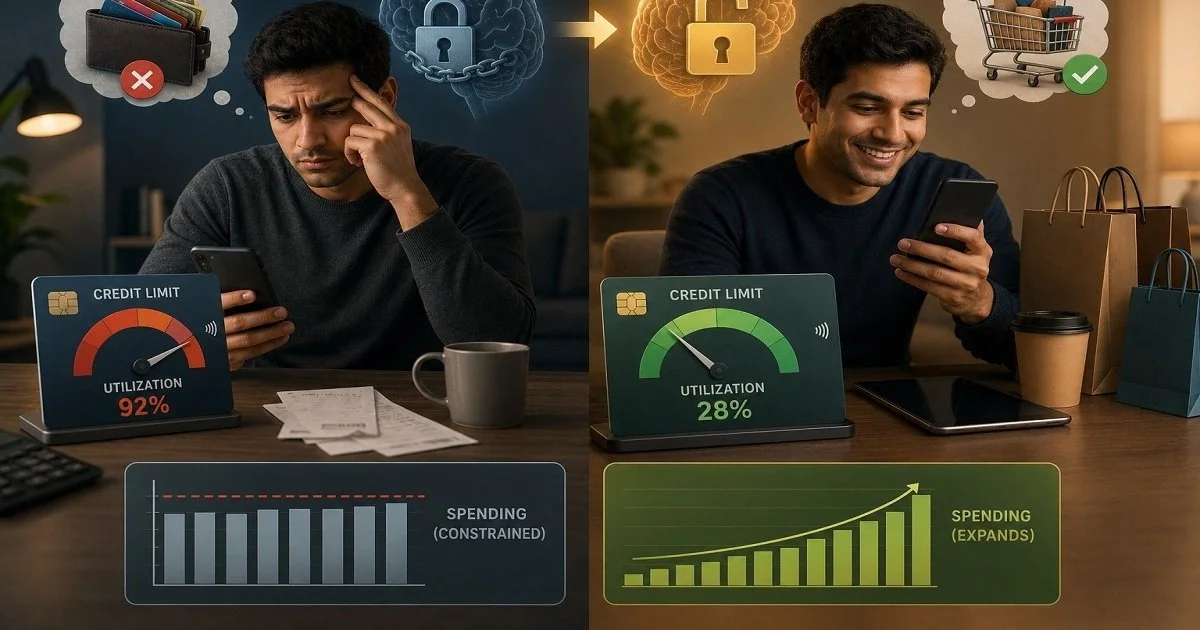
Every credit score guide recommends requesting a credit limit increase to lower your utilization ratio. The advice is mechanically correct: a higher limit on the same spending immediately reduces credit usage, which improves your score.
For a significant number of people, spending doesn’t stay the same after the limit increases, so the advice is incomplete. The psychological mechanisms that make a near-maxed card uncomfortable to spend on also work in reverse: a newly roomy limit quietly removes the friction that was suppressing spending, and balances rise to fill the new space.
This observation isn’t a reason to avoid limit increases altogether; for many people, these increases provide the exact score benefit they are intended to deliver. However, it is important to understand the specific mechanism by which a limit increase can backfire, so you can request one with the appropriate safeguards in place instead of assuming the benefit is automatic.
The Intended Effect vs. The Common Real-World Effect
Here’s the mechanism that works as intended, and here’s how it directly opposes the mechanism that works against you. Both are real results, and which one applies to you depends on your spending after the increase.
| The Intended Effect | The Common Real-World Effect | |
| Utilization ratio | Lower utilization on the same spend, a score benefit | Spend rises alongside the limit, leaving utilization unchanged or higher |
| Available credit | A larger safety buffer for genuine emergencies | A larger buffer that gets absorbed into routine discretionary spending |
| Monthly balance carried | Unchanged, you still pay in full | Grows in step with the new limit, sometimes triggering a balance for the first time |
| Credit score | Improves via lower utilization | Stagnates or declines if spending and balance both rise |
The arithmetic of the intended effect is simple: a Rs. 25,000 balance represents 25% utilization of a Rs. 100,000 limit, while it represents 12.5% utilization of a Rs. 200,000 limit. Nothing about the math is wrong. What changes the outcome is whether the Rs. 25,000 stays at Rs. 25,000, and for many people, it doesn’t, not through any single conscious decision but through a series of small ones that compound over months.
The Behavioral Mechanism: Why Spending Creeps Up
The phenomenon behind this behavior isn’t unique to credit cards; it’s a well-documented pattern in how people relate to any expandable resource. Applied specifically to credit limits, four mechanisms tend to drive the creep:
| Behavioural Mechanism | How It Plays Out | Why It’s Easy to Miss |
| Anchoring to the new limit | A higher limit subtly resets your mental sense of “normal” spending capacity, even though your income hasn’t changed | The shift happens gradually over weeks, not in a single noticeable decision |
| Reduced friction at the point of purchase | Knowing you have more headroom removes the small mental pause that a near-maxed card creates before a purchase | The removed friction doesn’t feel like a choice; it feels like the absence of an obstacle |
| The ‘I can afford it’ illusion | Available credit gets mentally counted as available money, even though it is borrowed money that must be repaid | Bank balances and credit limits look similar on a banking app screen, which blurs the distinction |
| Lifestyle creep tied to a credit event | A limit increase often coincides with a raise or new job; both events can trigger general spending increases that get misattributed to the limit increase itself, or compound with it | Multiple changes happening together make it hard to isolate which one is driving new spending habits |
Why is the phenomenon genuinely difficult to notice in the moment?
None of these mechanisms involve a single deliberate decision to “spend more because my limit went up.” They make dozens of small individual purchase decisions over weeks or months, each of which feels unconnected to the limit increase itself. By the time the pattern is visible in a monthly statement, it can already represent a meaningfully higher baseline than before.
Who Is Actually at Risk and Who Isn’t?
This effect does not apply equally to everyone. Here is an honest breakdown of which profiles are genuinely vulnerable to the spending-creep effect and which are not:
| Profile | Risk Level | Why |
| Has a history of carrying a balance on any card | High | A demonstrated pattern of spending up to available credit is the single strongest predictor of repeating that pattern at a new, higher limit |
| Requested the increase specifically to make a big purchase feel more comfortable | High | The intent behind the request already signals an expectation of spending into the new capacity, not just holding it in reserve |
| Tracks spending loosely, by available balance rather than a budget | Moderate-High | Without an independent budget, the credit limit itself becomes the de facto spending ceiling, and that ceiling just moved |
| Has multiple cards and tends to use whichever has the most headroom | Moderate | A newly increased limit becomes the most attractive card to reach for, redirecting spend toward it specifically |
| Has a strict monthly budget independent of any card’s limit | Low | Spending is governed by the budget, not by how much room is left on the card: a higher limit changes nothing behaviorally. |
| Requested the increase purely to lower utilization, with no spending change planned | Low | This is the textbook case where a limit increase delivers its intended score benefit with no behavioural downside |
The most significant distinction lies in whether your spending is controlled by an independent budget or by the available balance on your card. If a fixed monthly number, based on your income and expenses, determines what you spend regardless of your credit limit, a limit increase changes nothing behaviorally and delivers its intended score benefit cleanly. If your card’s remaining headroom serves as your spending guide, a higher limit directly increases that guide.
A Realistic Worst-Case Timeline
Here’s what the creep normally looks like over the course of a year for someone in the higher-risk bucket, not as a single dramatic moment but as a series of steps that each seem reasonable at the time to bring the mechanism into reality:
| Stage | What Happens | Balance | Effective Utilization |
| Before increase | Limit: Rs. 100,000. Spends Rs. 25,000/month, pays in full. | Rs. 0 (after payment) | 25% at statement date |
| The limit increased | New limit: Rs. 200,000. Spending habits unchanged initially. | Rs. 0 | 12.5% — score improves |
| 3–6 months later | Spending creeps up to Rs. 45,000/month as ‘available room’ gets used | Rs. 0 (still paid in full) | 22.5% — back near original level |
| 9–12 months later | A tight month leads to paying only the minimum for the first time | Rs. 30,000 carried forward | 15%+ AND now accruing interest |
Notice what makes this timeline dangerous: at no single stage does it feel like a crisis. Stage 2 is a genuine win; utilization drops and the score improves exactly as intended. Stage 3 feels like normal life, a few extra purchases here and there, still paid in full. It’s only by Stage 4, nine to twelve months after the original increase, that the cumulative effect of the unnoticed creep becomes visible as an actual carried balance, the first one this cardholder has had in years.
The Five Safeguards That Prevent the Creep
None of this is to say limit increases are bad; it just means they work best with a small number of deliberate safeguards in place, rather than assuming the benefit is automatic:
| Safeguard | How to Implement It | What It Protects Against |
| Set a personal spending ceiling independent of the limit | Decide your monthly card budget based on your income and expenses and write it down, before requesting or accepting any increase | Prevents the new limit from silently becoming your new spending target |
| Request the increase, but don’t change any spending habits for 90 days | Treat the first 3 months post-increase as a deliberate observation period and track whether your spend has moved at all | Surfaces creep and spend early, while it’s still a small and easily reversible shift |
| Set a balance alert below your OLD limit, not the new one | Most banking apps allow custom balance alerts. Set yours at your previous limit as an early warning trigger | Flags the moment your new spending exceeds what used to be your entire capacity |
| Decline limit increases tied to a specific upcoming purchase | If a bank offers an increase right as you’re planning a large purchase, pause and ask whether you’d request this increase without that purchase in mind | Separates a genuine utilization-improvement goal from a rationalisation for spending more |
| Review your utilization trend, not just your current snapshot | Check your utilization percentage monthly for 6 months after any increase, not just once right after | Catches a slow drift back toward your original utilization percentage before it becomes a real balance |
The single most effective safeguard
The one that does the most work of the five safeguards above is to establish a personal spending limit outside your credit limit and write it down before you ask for or accept any increase. All other safeguards are really about catching a problem after it’s begun; this one stops the new limit from ever becoming your de facto spending target in the first place.
Should You Still Request a Limit Increase?
For most people, the answer is yes, provided that the safeguards mentioned above are in place. A higher limit genuinely improves your utilization ratio, which is 30% of your credit score, and a larger available-credit buffer is a real benefit for genuine emergencies. The goal of this guide is not to discourage limit increases but to replace the unexamined assumption that the benefit is automatic with an honest understanding of the one condition that determines whether it actually is: whether your spending stays anchored to a budget or drifts to match whatever room is available.
If you have a demonstrated history of spending up to whatever limit you’re given, the safest path may be requesting the increase specifically for the utilization benefit while deliberately treating the new headroom as off-limits, effectively keeping your real spending ceiling exactly where it was before the increase, on paper as well as in practice.
Final Thoughts
A credit limit increase is one of the few credit-building tips that can backfire if applied without understanding spending psychology. Lower utilization on stable spending is a real, calculable score benefit, but it silently assumes spending behavior won’t change in response to more credit, which is a blind spot in how the advice is applied.
An increase in spending limits is almost free for someone with an independent budget. A limit increase can quietly set the stage for a higher balance than a person has ever carried, not through one bad decision but through months of reasonable ones. Knowing your category truly makes a significant difference.