





The MACD (Moving Average Convergence Divergence) is a helpful way to check Elliott Wave counts because it shows how momentum changes wave patterns. The MACD peaks during the third wave, and the price differences during the fifth wave show that the trend is about to change. Traders can use normal MACD settings (12, 26, 9), market trends, MACD peaks and troughs, divergences, and changes in the MACD histogram to figure out when waves will change and make better trading decisions.
You’re not the only one who has had trouble figuring out where one Elliott Wave ends and another begins. Wave counting can be hard for many traders because price changes often seem random.
But here’s the good news: the MACD can help a lot! You will start to see patterns that used to look random when you learn how to use MACD to find Elliott waves. Let’s get started and see how this system works step by step.
MACD and Elliott Wave
The MACD (Moving Average Convergence Divergence) is a great way to double-check Elliott Wave counts. Why? This is due to its ability to visually display momentum, which is the driving force behind the movement of waves.
In short, MACD shows you when a trend is getting stronger or weaker. If the MACD line moves away from the price chart, it could mean that a reversal is coming. This indicator is exactly what Elliott Wave analysts look for when they want to know when Wave 5 ends or when a new motive wave starts.
When you use Elliott Wave analysis,
- The third wave, which is usually the strongest, lines up with the MACD peaks.
- The fifth wave is when the price and MACD often diverge, which means the end of a motive phase.
- During corrections (A-B-C), MACD helps you see when a correction phase ends and a new impulse begins.
The combination of momentum and structure in MACD makes it a great tool for counting waves.
Identify an Elliott Wave Using MACD
Let’s look at a real-life example to see how this indicator works.
Let’s take a look at Maruti Suzuki India’s 1-hour chart from the middle of August to the end of September 2025. At this point, the market price was steadily rising after a short correction, which was a clear sign of a motive wave.

Now, if you look at the MACD oscillator, you’ll see something intriguing:
- The MACD line and histogram reach their highest point during Wave 3, which shows that the momentum is strong.
- The price is still going up when Wave 5 forms, but the MACD histogram starts to go down, which is a bearish divergence.
- This divergence means that the uptrend is about to end because the momentum is running out. This is a strong sign that you should get ready for a reversal or correction.
This signal is not just for bullish markets. In bearish trends, the same idea holds true: bullish divergence at the end of Wave 5 can be a sign that an upside reversal is coming.
Now let’s turn the chart around and look at a pattern that fixes things.
Take a look at the one-hour chart from December 2023 for ITC Ltd. After a long period of going up, the stock went through a clear correction phase. While the price went down slowly, the MACD line and histogram began to rise. This bullish divergence meant that the correction was almost over and that a new wave of buying could be on the way.
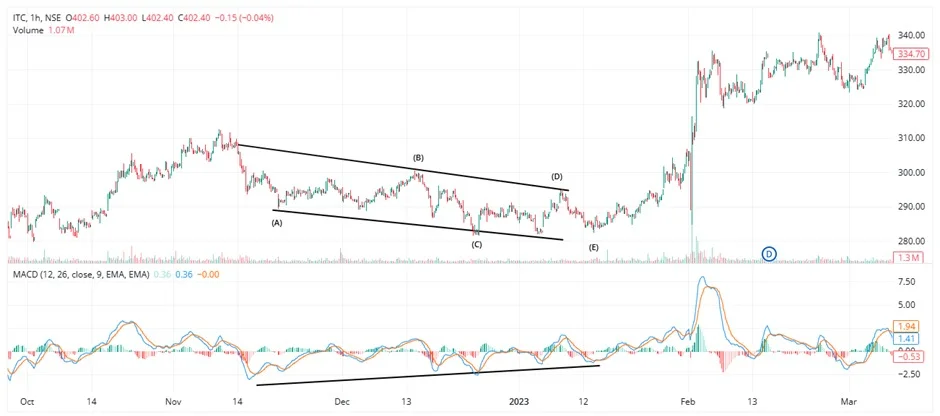
You can find the start of motive waves and the end of corrections by comparing MACD’s behavior to price action. This is a big plus because many traders have trouble finding those exact turning points.
When you use MACD to find Elliott Wave, keep the following in mind:
- Wave 3 Confirmation: The highest MACD peak usually lines up with Wave 3.
- Wave 5 Divergence: The price goes up, but the MACD doesn’t. This means that Wave 5 is running out of steam.
- End of Correction: If MACD diverges positively during A-B-C corrections, a new motive wave may start soon.
Each of these points helps you achieve a more accurate wave count, which means less guesswork and emotional trading.
How to Use MACD for Wave Counting
To use MACD to count waves correctly, do the following:
1. Set the MACD parameters to 12, 26, and 9
For most timeframes, these are the default settings that work well. You can make small changes for shorter or longer charts, but this setup gives signals that are in balance.
2. Look at the big picture first
Look for the overall trend on a longer time frame, like daily or weekly, before moving on to shorter ones. This makes sure you don’t count small changes as big waves.
3. Mark the MACD’s highs and lows
Look at the highs and lows of the prices. See how the MACD momentum is strongest in Wave 3 and weakest in Wave 5.
4. Look for differences
When the price and MACD move in different directions, that’s a positive sign. It helps you guess when reversals will happen, both at the end of motive waves and during corrective phases.
5. Use changes in the histogram
The MACD histogram is a useful way to see if momentum is changing before the crossover happens. When the bars in a histogram get shorter, it means that momentum is slowing down, which could mean that a wave is about to change.
When you put MACD signals and Elliott Wave patterns together, you get a powerful tool for double-checking that helps you time things better and feel more confident.
Final Thought
If you’ve been attempting to understand Elliott Wave theory but frequently find yourself uncertain about your wave counts, the MACD is the crucial component. It works like a compass for momentum, helping you get through the market’s highs and lows.
When you learn how to use MACD to find Elliott waves, you’ll not only get better at analyzing things, but you’ll also get fewer false signals. This method gives you a clear advantage when looking at Maruti Suzuki, ITC, or any other asset.
So, the next time you look at your trading chart, don’t just look at the price. Pay attention to how momentum moves behind it. When you start to see those MACD divergences, Elliott waves will no longer be mysterious patterns; they will be living examples of how people think about the market.
FAQ
What is the best indicator for an Elliott Wave?
There isn't one "best" indicator, but traders often use a mix of tools to double-check Elliott Wave counts.
The MACD is one of the best because it shows the momentum pattern of each wave. The histogram peak is usually strongest during Wave 3 and weakest during Wave 5.
You can also use Fibonacci retracements, RSI, or volume analysis to double-check that the wave structure follows Elliott's rules. The most important thing is confluence, which means that many confirmations point to the same wave pattern.
Which indicator works best with MACD?
When used with RSI (Relative Strength Index) or moving averages, the MACD works best.
- RSI helps confirm whether a stock is overbought or oversold when it crosses over or diverges from the MACD.
- Moving averages smooth out price changes and show the overall trend's direction.
MACD + RSI or MACD + MAs together give you a better idea of momentum, strength, and possible wave reversals. This is excellent for improving Elliott Wave analysis.
Disclaimer
This post is just meant to give you information; it is not financial advice. Trading and investing are risky, and results from the past don’t always mean results in the future. People who want to invest or trade should do their research and think about their situation before making a decision. This content’s author and platform are not responsible for any damages or losses that happen because of its use. Get personalized help from a qualified financial expert.

Satyajit Baidya
He is an option writer who came to the markets through curiosity and stayed through conviction. He studies price action through the lens of Elliott Wave theory and draws his trading philosophy from Jesse Livermore—the belief that discipline, timing, and patience matter more than predictions do. A student of history by training, he sees the market as just another chapter in a very long story: the details change, the patterns don’t.