





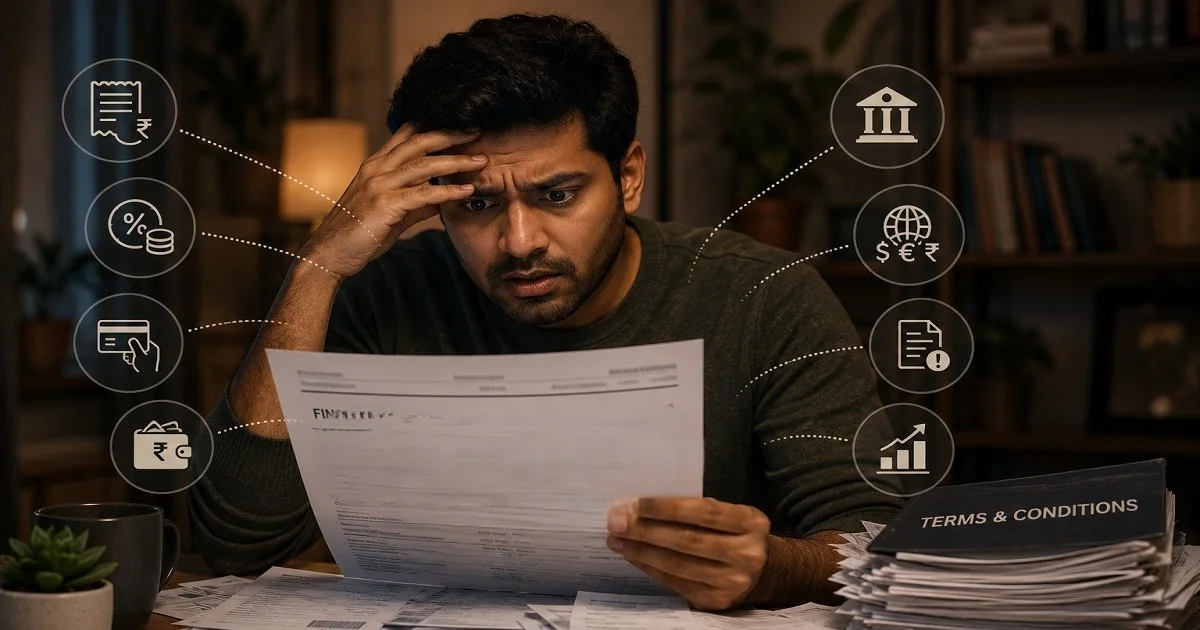
You check your credit card statement, and you spot a charge you don’t recognize. Not a purchase—it’s something called a ‘finance charge. ‘ Below it, a ‘cash advance fee.’ Further down, a ‘cross-currency markup.’ You paid them all without knowing what they were for.
You are not alone. Indian credit cards can carry up to 13 or more distinct fee types, most of them buried in the Most Important Terms and Conditions document that arrives with your card and is almost never read. For the average cardholder, these unknown fees quietly add Rs. 3,000 to Rs. 10,000 per year in avoidable charges.
Every Credit Card Fee at a Glance
Before the deep dive, here is the complete reference table. Each fee is covered in detail in the sections that follow.
| Fee Type | Typical Amount (India) | Avoidable? |
| Annual / Renewal fee | Rs. 0 – Rs. 10,000+ | Often yes (spend waiver) |
| Joining fee | Rs. 0 – Rs. 5,000 | Sometimes (first-year-free) |
| Finance charge (interest) | 30%–42% APR | Yes (pay in full monthly) |
| Late payment fee | Rs. 100 – Rs. 1,300 | Yes (auto-pay) |
| Cash advance fee | 2.5%–3.5% + interest | Yes (avoid cash withdrawals) |
| Foreign transaction fee | 1.5%–3.5% | Yes (use the right card). |
| Over-limit fee | Rs. 500 – Rs. 600 | Yes (stay within the limit). |
| Payment return fee | Rs. 250 – Rs. 500 | Yes (maintain auto-pay balance) |
| Fuel surcharge | 1% of transaction | Partially (many cards are waived). |
| GST on fees | 18% on all charges | No (mandatory) |
| Reward redemption fee | Rs. 50 – Rs. 99 | Sometimes (batch redemptions) |
| Card replacement fee | Rs. 100 – Rs. 300 | Yes (keep card safe). |
| EMI conversion fee | 1%–2% of the amount | Partially (no-cost EMI exists) |
The two categories that matter most
Generally credit card costs are either behavior-driven (finance charges, late fees, and cash advance fees) or bad card selection-driven (annual fees, foreign fees, and gasoline surcharges). The first category includes changes in consumer behaviors. Changing credit cards affects the second category of costs. Most cardholders need to address both.
Annual Fee and Renewal Fee
The annual fee—sometimes called the renewal fee from the second year onward—is a flat charge levied once per year simply for holding the card. It is typically debited on the anniversary of your card issuance date.
Annual fees in India range from zero (lifetime-free cards) to Rs. 10,000 or more for super-premium cards offering airport lounge access, travel credits, and concierge services. The joining fee is the equivalent charge in the first year; some cards charge both, while many waive the joining fee entirely as an acquisition incentive.
The Spend-Waiver System
The most common fee structure in India is the spend waiver: your annual fee is reversed if you cross a minimum spend threshold during the year. For example, a card with an Rs 1,500 annual fee may waive it entirely if you spend Rs 150,000 in the year—approximately Rs 12,500 a month.
To evaluate whether a spend waiver works for you, calculate your average monthly card spend, multiply by 12, and check whether you comfortably exceed the threshold. If you do, the annual fee is effectively zero. If you typically fall short, a lifetime-free card is the financially smarter choice.
The GST Layer
All yearly prices include 18% GST. The annual fee for Rs. 1,000 is Rs. 1,180. The entire cost is Rs 5,900, including an annual charge of Rs 5,000. Include this figure in any break-even analysis.
How to evaluate a high-annual-fee card
Add up every reward, benefit, and waiver the card provides in a typical year—cashback, lounge visits, travel credits, and insurance coverage. If the total value comfortably exceeds the annual fee, including GST, the card earns its cost. You are supporting your bank if the rewards don’t surpass the fee.
Actionable tip: Set a calendar reminder 45 days before your card anniversary. Check whether you have met the spend waiver threshold. If you are close, a qualifying purchase before the anniversary date can save you the entire annual fee.
Finance Charge (Interest / Revolving Credit Charge)
The finance charge is the interest applied to any balance you carry past your payment due date. By a significant margin, it is the most expensive fee on any credit card—and the one that causes the most long-term financial damage.
How It Is Calculated
Finance charges in India are calculated using the average daily balance method:
- Your Annual Percentage Rate (APR) is divided by 365 to get a daily rate.
- That daily rate is multiplied by your average daily balance across the billing cycle.
- The result is your finance charge for the month.
At 36% APR, the monthly rate is 3%. At 42% APR, it is 3.5% per month. These are among the highest interest rates on any consumer financial product in India—higher than most personal loans and far higher than home or auto loan rates.
The Grace Period Trap
The most consequential thing that most cardholders do not know is that carrying any balance—even Rs. 1—from one month to the next eliminates the grace period for all new purchases in the following cycle. Once you carry a balance, every new transaction begins accruing interest from its purchase date, not from the statement date.
This means a cardholder who pays 99% of their balance but leaves Rs. 1 unpaid loses the interest-free window on their entire next month’s spending. The finance charge is not proportional to what you left unpaid — it applies to everything.
The annual cost at 42% APR
Rs. 10,000 carried for one full year at 42% APR costs Rs. 4,200 in interest alone. Carrying Rs. 50,000 for a year incurs a cost of Rs. 21,000. That is money paid to your bank for the privilege of not clearing your balance—with no goods or services received in return.
How to avoid entirely: Pay the full statement balance by the due date every month. This single habit eliminates the finance charge completely, regardless of how much you spend.
Late Payment Fee
The late payment fee is a flat penalty charged when you miss your payment due date entirely or pay less than the minimum amount stated on your statement. Unlike the finance charge, which is percentage-based, the late payment fee is tiered by the size of your outstanding balance.
Standard Tier Structure in India
| Outstanding Balance | Typical Late Payment Fee |
| Up to Rs. 100 | Nil |
| Rs. 101 – Rs. 500 | Rs. 100 |
| Rs. 501 – Rs. 5,000 | Rs. 500 |
| Rs. 5,001 – Rs. 10,000 | Rs. 750 |
| Rs. 10,001 – Rs. 25,000 | Rs. 950 |
| Rs. 25,001 – Rs. 50,000 | Rs. 1,100 |
| Above Rs. 50,000 | Rs. 1,300 |
The Double Penalty
Missing a payment does not just trigger the late fee—it triggers two simultaneous penalties. First, you will incur the flat late payment fee mentioned earlier. Second, your grace period will be removed, meaning that finance charges will start accruing on your balance from the purchase date of every transaction within that billing cycle.
The total cost of a single missed payment on a Rs. 20,000 balance includes the Rs. 950 late fee, finance charges for the entire billing cycle, and the loss of the grace period on next month’s purchases. A momentary oversight can easily cost Rs. 1,500 to Rs. 2,000 in combined charges.
The Credit Score Dimension
The financial cost is only part of the damage. A missed payment is reported to all four credit bureaus and can drop your CIBIL score by 50 to 100 points immediately. That entry stays on your record for years. The reputational cost to your credit profile far exceeds the fee itself.
The single most effective protection
Set up auto-pay for at least the minimum amount due on every credit card account you hold. Auto-paying the minimum does not prevent finance charges—but it ensures your payment history stays clean, which protects your credit score even during months when cash flow is tight.
Cash Advance Fee
The cash advance fee is charged when you use your credit card to withdraw cash at an ATM or conduct any transaction classified as a cash advance. It is one of the most expensive and least understood fees in the credit card fee structure.
Three Costs Apply Simultaneously
Unlike most credit card fees, a cash advance triggers three separate charges at the same time:
- Cash advance fee: Typically 2.5% to 3.5% of the amount withdrawn, subject to a minimum of Rs. 250 to Rs. 500 plus 18% GST.
- Interest from day one: No grace period—interest at your card’s full APR (36%–42%) is charged at the moment of withdrawal, not on the statement date.
- ATM network charges: The ATM operator can levy an additional withdrawal fee, which is usually Rs. 20 to Rs. 50 per transaction.
Example: ATM withdrawal of Rs. 10,000
- Cash advance fee (2.5%): Rs. 250 + GST = Rs. 295
- Interest at 36% APR for 30 days: Rs. 10,000 x 3% = Rs. 300
- ATM Network Charge: Rs. 21
- Additional cost for 30 days: Rs. 616
You borrowed Rs. 10,000, and it cost Rs. 616 in fees and interest for a single month—a 6.16% premium on a 30-day window. Annualized, that is roughly 74%. There is no consumer financial product in India pricier than a cash advance from a credit card.
What Counts as a Cash Advance
Cash advances extend beyond ATM withdrawals. The following transactions are typically classified as cash advances on most Indian credit cards:
- ATM cash withdrawals
- Loading prepaid wallets above certain thresholds
- Purchasing foreign currency or traveller’s cheques
- Certain government payments and utility bill payments (card-specific—check your terms)
- Cryptocurrency purchases on most platforms
The rule: never use a credit card for cash
If you need emergency cash, a personal loan or a debit card overdraft is dramatically cheaper than a credit card cash advance. The combination of an upfront fee, immediate interest accrual, and no grace period makes the cash advance one of the worst financial products available to Indian consumers. Avoid in virtually every circumstance.
Foreign Transaction Fee (Forex Markup)
The foreign transaction fee—also called the forex markup, cross-currency fee, or foreign currency surcharge—is charged for any transaction made in a foreign currency or processed through a foreign payment network. Critically, the fee includes online purchases made on international websites while you are sitting in India.
How It Is Calculated
The forex markup is applied as a percentage of the transaction value after currency conversion, typically ranging from 1.5% to 3.5% depending on the card and issuer. But the stated markup is not the full cost — there is a hidden layer underneath it.
The card network, be it Visa or Mastercard, converts the foreign currency into Indian rupees at its exchange rate before applying the forex markup. This conversion rate includes a margin of 0.5% to 1% above the interbank rate. The real cost of a foreign currency transaction is the forex markup plus the conversion spread, which normally ranges from 2% to 4.5% overall.
When It Applies
• Purchases on international e-commerce sites—Amazon US, eBay, Booking.com, Etsy, and Airbnb—even from India
• Any transaction billed in a currency other than INR
• Foreign purchases at physical stores abroad
• Dynamic Currency Conversion (DCC) is offered at international merchants—always decline and pay in local currency.
The Dynamic Currency Conversion Trap
When you use your card abroad, merchants sometimes offer to charge you in INR rather than the local currency. This is called ‘dynamic currency conversion,’ and it consistently offers a worse exchange rate than your card’s standard conversion. Always choose to pay in the local currency—your bank’s conversion rate, even with a forex markup, is almost always better than DCC.
Worked Example: A Short International Trip
USD 500 (approx. Rs. 41,500) for a card with a 3.5% forex markup:
• Forex markup: 3.5% × Rs. 41,500 = Rs. 1,453
• Conversion spread (estimated 0.75%): Rs. 311
• Total forex cost: approximately Rs. 1,764 on a single trip
Zero-forex cards: a genuine saving for frequent international spenders
Several Indian cards now offer zero forex markup—including Niyo Global, IDFC FIRST Bank, and various co-branded travel cards. If you spend Rs. 200,000 abroad every year, a zero-forex card can save you anywhere between Rs. 4,000 and Rs. 7,000 in markup fees in a year. For the frequent international shopper, the difference in card choice can mean the difference between saving money or spending more.
Over-Limit Fee
If you exceed your approved credit limit, you will incur an over-limit fee. A generic fee of Rs. 500 to Rs. 600 plus 18% GST equals Rs. 590 to Rs. 708.
Over-limit situations most commonly arise not from large purchases but from the accumulation of smaller charges: interest postings, annual fees, and late fees can push a balance that was just within the limit fractionally above it.
RBI Regulation
The Reserve Bank of India requires issuers to obtain explicit written consent from cardholders before allowing over-limit transactions. Most issuers now decline transactions that would breach the credit limit rather than permitting them and charging the fee. However, interest and fee postings, which happen automatically on the issuer’s system, can still push a balance above the limit even when purchase transactions are blocked.
How to avoid it: Keep your use far below your credit limit. The conventional recommendation to keep usage below 30% provides a comfortable cushion against unintentional over-limit situations caused by charge and interest postings. Set alerts in your credit card app for when you are approaching your limit.
GST on Credit Card Fees
An issuer will levy an 18 percent Goods and Services Tax on every credit card charge. This is a statutory charge that cannot be negotiated; it applies to annual fees, late payment fees, cash advance fees, over-limit fees, card replacement fees, and all other issuer charges.
What GST Applies and What Does Not Apply
-
GST is applicable on annual fees, late payment fees, cash advance fees, Forex markup fees, over-limit fees, EMI processing fees, reward redemption fees, and card replacement fees.
-
GST does not apply to the finance charge (interest) itself—interest income is exempt from GST under Indian tax law.
The Real Cost With GST
| Fee | Base Amount | GST (18%) | Total Charged |
| Annual fee | Rs. 1,000 | Rs. 180 | Rs. 1,180 |
| Late payment fee | Rs. 500 | Rs. 90 | Rs. 590 |
| Cash advance fee | Rs. 250 | Rs. 45 | Rs. 295 |
| Over-limit fee | Rs. 500 | Rs. 90 | Rs. 590 |
| Card replacement | Rs. 200 | Rs. 36 | Rs. 236 |
Always remember to include GST when working out the real cost of any credit card fee. A card being sold for an annual fee of Rs. 999 is actually costing Rs. 1,179. This is more relevant for high-fee premium cards where the annual fee could go up by Rs 900 to Rs 1,800 in GST alone.
9. Fuel Surcharge and Waiver
The fuel surcharge is an additional fee that fuel stations place on credit card transactions, and the card issuer passes that charge on to the cardholder. The standard surcharge is 1% of the transaction value, with 18% GST applied on top of the surcharge—making the real effective rate approximately 1.18% per transaction.
How It Works in Practice
Most fuel surcharge waivers apply only within a specific transaction value range—typically Rs. 400 to Rs. 4,000 per fill-up, though the exact range varies by card. Transactions outside this range may not qualify for the waiver. The waiver is generally credited to your statement within one to two billing cycles, not applied at the point of sale.
The Annual Value
The 1% surcharge (plus GST) works out to roughly Rs. 94 a month for a cardholder spending Rs. 8,000 a month on fuel—Rs. 1,130 a year. A card that offers an unlimited fuel surcharge waiver within eligible transactions saves nearly this entire amount annually. For many entry-level cards, this single benefit exceeds the annual fee.
Check the eligible transaction range
Before relying on a fuel surcharge waiver, confirm the transaction range on your specific card. Some cards waive the surcharge only on transactions between Rs 500 and Rs 3,000. If you buy a single fuel worth Rs. 5,000 on such a card, you will be charged the entire surcharge. Splitting a large fill-up into two transactions to stay within the range is a common—and legitimate—optimization.
Reward Redemption Fee
The reward redemption fee is a processing charge levied by some issuers when you redeem accumulated reward points. The irony of paying a fee to access rewards you have already earned is not lost on most cardholders—it is a real cost that erodes the effectiveness of your reward program.
When It Applies
Redemption fees typically apply to statement credit or direct cash credit redemptions—essentially, converting points to money. Many issuers waive the fee for catalog redemptions (merchandise, vouchers) or specific partner redemptions, charging it only when you request cash value.
Typical charges are Rs 50–99 + 18% GST. A redemption fee of Rs 99 on Rs 500 worth of points is a 20% hidden charge on the rewards earned by a low spender with a small points balance.
How to Minimise
- Batch redemptions: Wait until you have more points to redeem to lower the percentage fee.
- Pick redemption categories that are fee-free: vouchers, merchandise, and partner redemptions are often exempt.
- Check your card’s terms: Some premium cards waive the redemption fee entirely—that’s a big difference for big spenders who accumulate many points.
EMI Conversion Fee and Interest
When you convert a large credit card purchase into equal monthly installments, the bank structures a loan on top of your existing credit card account. Two cost components may apply: an upfront processing fee and ongoing interest on the EMI balance.
Two Types of EMI
- Interest-bearing EMI: a standard installment plan at a monthly interest rate—typically 12%–24% APR. This is substantially lower than the revolving credit rate of 36% to 42%, which is why EMI conversion is often worth considering for large purchases you cannot pay in full immediately.
- No-cost EMI: marketed as zero interest, but the mechanics are less transparent. In a genuine no-cost EMI, the merchant absorbs the interest cost by providing an upfront discount equal to the interest amount. The “no-cost” product is typically the regular price with the interest funded elsewhere—not a genuine additional benefit in most cases.
Processing and Foreclosure Fees
- Processing fee: Typically 1% to 2% of the transaction value, minimum Rs 99 to Rs 199 + 18% GST—levied upfront at the time of EMI creation.
- Foreclosure fee: If you want to close the EMI plan early, some issuers charge 1% to 3% of the remaining principal—check before committing to EMI if you want to pay it off prematurely.
Understand when EMI is beneficial and when it is not.
An EMI conversion is useful if you cannot afford to pay for a large planned purchase (appliances, electronics, and travel bookings) in full this month. At 12%–18% APR, it is significantly cheaper than revolving credit at 36%–42%. It does not make sense for converting existing debt—a personal loan at a similar rate achieves the same with more flexibility and without processing fees.
Other Fees Worth Knowing
Payment Return / Cheque Bounce Fee
Banks charge when card payments are returned due to insufficient funds in the linked account. The cost is Rs. 250–500 plus GST. More importantly, a bounced payment can incur a late payment fee and a loss of your grace period. Check your linked bank account for funds before auto-pay or standing instruction dates.
Card Replacement Fee
Requesting a replacement card for a damaged, lost, or stolen card costs money. The usual fee is Rs. 100–300 plus GST. Many issuers waive the first replacement or waive it entirely for premium cardholders. If your card is lost or stolen due to fraud, the replacement is usually free—confirm with your issuer.
Statement Request Fee
Some issuers charge for physical duplicate statements or statements older than a certain period—typically Rs. 50 to Rs. 100 per statement. Digital statements are universally free. Opt for e-statements on every card you hold and download or save statements regularly to avoid needing to request them.
Fees You Can Avoid—and Fees You Cannot
Here is the complete picture, organized by what you can actually do about each fee:
| Category | Fees Included | How to Avoid |
| Cannot avoid | GST on all charges; currency conversion spread | Cannot be avoided—factor into fee calculations |
| Avoid bad habits | Finance charge, late payment, cash advance, over-limit, payment return | Pay in full, set up auto-pay, and never use a card for cash. |
| Avoid the right card | Annual fee, foreign transaction fee, fuel surcharge, redemption fee | Choose a lifetime-free, zero-forex, or waiver-eligible card |
Fees Completely Avoidable with the Right Habits
- Finance charge: pay the full statement balance by the due date every month
- Late payment fee: set up auto-pay for at least the minimum on every card
- Cash advance fee: Never use a credit card for ATM withdrawals or cash transactions
- Over-limit fee: keep utilization well below your credit limit; enable balance alerts
- Payment return fee: maintain sufficient balance in your linked account before auto-pay dates
Fees Reducible or Eliminable with the Right Card
- Annual fee: choose a lifetime-free card or a card whose spend waiver you reliably meet
- Foreign transaction fee: use a zero-forex-markup card for all international and online foreign currency transactions
- Fuel surcharge: use a card with a fuel surcharge waiver within the eligible transaction range
- Reward redemption fee: choose a card with fee-free redemption or batch redemptions to minimize per-redemption cost
Fees That Cannot Be Avoided
- GST (18%): applied to all issuer charges by statute—cannot be negotiated or waived
- Currency conversion spread: built into the network’s exchange rate on every foreign currency transaction—unavoidable but minimized by using a zero-forex card
How to Audit Your Own Credit Card Fees in 5 Steps
Most cardholders have never calculated how much they actually pay in fees versus how much they earn in rewards. This five-step audit takes approximately 30 minutes and often reveals that a card change or habit change is worth thousands of rupees per year.
| Step | Action | What to Look For |
| Step 1 | Pull last 12 months of statements | Any line item that is not a purchase or repayment |
| Step 2 | Categorise every fee | Match each charge to the master fee list |
| Step 3 | Identify avoidable fees | Finance charges, cash advances, late fees, forex fees |
| Step 4 | Calculate annual fee drag | Total fees paid minus total rewards earned |
| Step 5 | Decide on next action | Change habits, change card, or both |
What to Do With the Results
If avoidable fees exceed rewards earned, the priority is changing habits, not cards. If you set up auto-pay, stop taking cash advances, and commit to paying off the full balance, you’ll immediately improve your net position—regardless of which card you hold.
If the annual fee is greater than the rewards earned, assess whether it is feasible to meet the spending waiver requirement. If it isn’t realistic, a no-annual-fee card that offers flat-rate cashback is likely a better option for your spending habits.
If forex fees are high, a zero-forex card will pay for itself on the first international trip for most travelers. The most significant change you can make for frequent international spenders is the card choice.
Read your MITC document
Every credit card comes with a Most Important Terms and Conditions document that lists every fee, charge, and rate applicable to your card. It is now available digitally through your card app or net banking portal. The 20 minutes it takes to read it could save Rs. 3,000 to Rs. 10,000 per year in avoidable fees—and will answer every question your bank hopes you never ask.
Final Thought
Credit card fees are usually optional and understandable if you know where to look. Cardholders who understand the fee structure pay almost none, while those who don’t can pay several thousand rupees per year for unused services. Your two most powerful actions today: Set up auto-pay for all card statement balances and read your MITC for 20 minutes. The first eliminates finance and late fees. The second details each fee’s cost and application.
FAQ
Why do I get charged a foreign transaction fee, and how can I avoid it?
Foreign transaction fees (1-3%) cover currency conversion and cross-border payment processing. You can avoid them by choosing a card explicitly marketed as having "no foreign transaction fees," which are common among travel rewards cards.
Is a balance transfer fee worth paying to move debt to a lower-interest card?
Often, it is worth paying a balance transfer fee if the calculations indicate a financial benefit. Balance transfer fees usually run 3-5% of the amount moved, but if you're escaping a high-interest card for one with a 0% introductory APR, the interest savings can far outweigh the one-time fee—just calculate the breakeven point first.
What triggers a cash advance fee, and why is it so expensive?
If you use your credit card to get cash (from an ATM or by check linked to your card), you will be charged a cash advance fee. Cash advances are costly because you pay a flat fee upfront (typically 3% to 5%) plus interest, which usually begins immediately, with no grace period as you have with regular purchases.
Can I get fees waived or refunded if I ask?
Sometimes. Late fees and occasionally annual fees can be waived—especially for cardholders with an excellent payment history who call and ask or as a retention offer if you mention considering canceling them. It's not guaranteed, but it costs nothing to try.


thanks
ok
The article presents several useful ideas to consider today and I look forward to reading more from you