





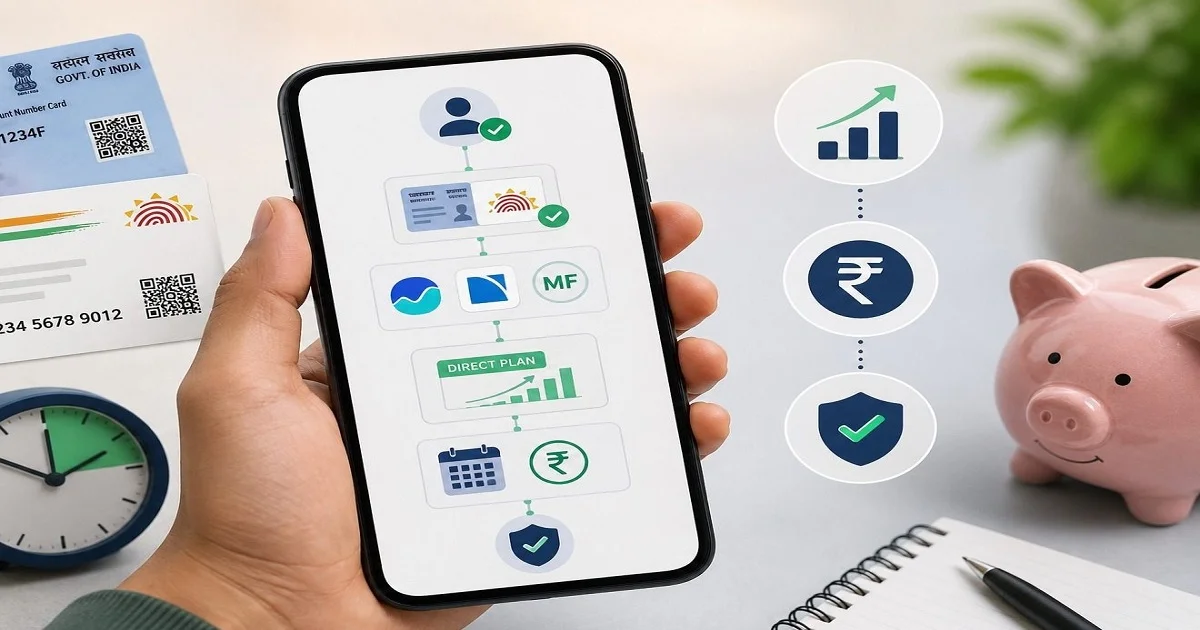
You can start a SIP in India in under 15 minutes: complete your KYC using PAN and Aadhaar, choose a platform (Groww, Zerodha Coin, or MF Central), pick a Direct Plan fund, set your SIP amount and date, and authorize UPI AutoPay or an e-mandate.
A Systematic Investment Plan, or SIP, is the easiest and most disciplined way to enter the stock market without needing to time it, understand it deeply, or check it daily. You commit a fixed amount every month, it gets auto-debited from your bank account, and a mutual fund buys units on your behalf. Over the years, that small habit compounds into real wealth.
What You Need Before You Start
Before you open any app or fill out any form, keep these three things ready:
- PAN card—mandatory for any mutual fund investment in India, no exceptions
- Aadhaar-linked mobile number—required for instant eKYC and UPI AutoPay verification
- A bank account with net banking or UPI enabled—this is where your SIP amount will be debited from.
Good to know
You do not need a Demat account to invest in mutual funds, unless you specifically choose to hold them in Demat form. Most beginners invest in the standard ‘statement form,’ which requires only a PAN, Aadhaar, and a bank account.
Step 1—Complete Your KYC
KYC (Know Your Customer) is a one-time regulatory requirement set by SEBI for every mutual fund investor in India. Once done, it works across all AMCs and platforms—you never have to repeat it.
How to complete eKYC (takes about 5 minutes)
Step 1: Go to MF Central (mfcentral.com), CAMS (camsonline.com), or KFintech (kfintech.com) or just start the process on your favorite investment platform (Groww, Coin, etc.), and it will take you through KYC automatically.
Step 2: Provide your PAN number. If you are KYC registered, KYC verified, or not KYC compliant, the system will notify you instantly.
Step 3: If you haven’t been verified yet, then go ahead with the eKYC verification process using Aadhaar. Provide your Aadhaar number and then enter it again using an OTP received on your registered mobile number.
Step 4: Upload your selfie and signature. Some websites might ask for these documents for full verification. Furthermore, if required, record a small video for the In-Person Verification (IPV) process.
Step 5. Submit. Most eKYC approvals are instant to 24 hours.
How to check your KYC status
Go to cvlkra.com or kra.ndml.in, enter your PAN, and you’ll see your current KYC status. If it shows “KYC Verified” or “KYC Registered,” you’re ready to invest with any AMC or platform in India.
Step 2—Choose Your Platform
You can invest in mutual funds in two broad ways: directly through an AMC or through a third-party investment platform. For most beginners, a platform offers a far smoother experience while still letting you buy direct plans at zero extra cost.
| Platform | Best For | Min. SIP | Direct Plans? | Mandate Options |
| MF Central | No middleman, official AMFI/RTA platform | ₹500 (varies by fund) | Yes | Net banking, UPI |
| Groww | Easiest UI for absolute beginners | ₹100–₹500 | Yes | UPI AutoPay (up to ₹15,000/day), e-Nach (up to ₹1 lakh) |
| Zerodha Coin | Investors already using Zerodha for stocks | ₹100–₹1,000 | Yes | UPI AutoPay (up to ₹1 lakh/day), Bank e-Nach |
| INDmoney | Strong analytics and portfolio tracking | ₹100–₹500 | Yes | UPI AutoPay, e-Nach |
| AMC website (direct) | Investing only in one fund house’s schemes | ₹100–₹1,000 | Yes (default) | Net banking, UPI, e-Nach |
Direct Plan vs. Regular Plan—Choose Direct every time
This choice is the single most important decision that affects your long-term returns. Every mutual fund is sold in two versions:
- Regular Plan—sold through a distributor or agent, who earns an ongoing commission (built into a higher expense ratio, typically 0.5%–1.5% more per year)
- Direct Plan — bought directly without any distributor commission, resulting in a lower expense ratio and higher returns to you
The real cost of choosing regular over direct
On a ₹10,000/month SIP over 20 years, a 1% higher expense ratio (typical regular vs. direct gap) can cost you ₹15–25 lakh in lost returns, purely due to compounding. All platforms listed above let you select “Direct Plan” at no extra cost—always choose it unless you specifically want a human advisor’s ongoing guidance.
Step 3—Select Your Fund
With KYC done and a platform chosen, the next decision is which fund to invest in. Match your fund choice to your goal and time horizon:
| Your Goal / Horizon | Fund Type to Consider |
| 3–5 years (short-term goal) | Balanced Advantage Fund or Conservative Hybrid Fund |
| 5–7 years (medium-term goal) | Large-Cap Fund or Flexi-Cap Fund |
| 7–10+ years (long-term goal, retirement) | Nifty 50 Index Fund, Flexi-Cap Fund, or a mix of large and mid-cap |
| Tax-saving (lock-in acceptable) | ELSS Fund (3-year lock-in, eligible for 80C under Old Tax Regime) |
The index fund shortcut for total beginners
If you genuinely have no idea where to start, a Nifty 50 index fund (such as UTI Nifty 50 Index Fund or HDFC Index Fund Nifty 50 Plan) is the simplest, lowest-cost option. It mirrors India’s top 50 companies, charges a minimal expense ratio (around 0.2–0.3%), and requires no ongoing fund-manager evaluation from you.
Step 4 — Set Your SIP Amount and Date
Minimum SIP amounts in 2026
SIP investing in India has become more accessible than ever. SEBI and AMFI have actively pushed for smaller ticket sizes to widen participation:
- Standard minimum SIP: ₹100–₹500/month, depending on the fund and platform
- SBI JanNivesh SIP: starts at just ₹250/month, with daily, weekly, or monthly options, available on SBI YONO, Paytm, Groww, and Zerodha.
- Kotak ‘Choti SIP’: starts at ₹250/month for first-time mutual fund investors; requires a minimum commitment of 60 monthly installments paid via NACH or UPI AutoPay
Best SIP date—does it actually matter?
A common myth is that the 1st, 5th, or 15th of the month is the best SIP date for higher returns. In reality, over a long investment horizon (5+ years), the specific date makes a negligible difference to your final returns—markets move too randomly day-to-day for any one date to consistently outperform.
What actually matters: pick a date 2–3 days after your salary credit date. This ensures the SIP amount is always available in your account and your auto-debit never fails.
Step 5—Set Up Auto-Debit (e-Mandate)
This feature makes a SIP truly “set and forget.” Instead of manually transferring money every month, you authorize your bank to automatically debit the SIP amount on your chosen date.
Option A: UPI AutoPay (fastest, recommended for most investors)
Step 1: On your chosen platform, go to Mandates (or something similar) and tap Create Mandate/Create AutoPay.
Step 2: Select UPI as the method and enter your UPI ID.
Step 3. Approve the mandate request on your UPI app (Google Pay, PhonePe, Paytm, etc.)—a token amount of ₹1 may be debited and refunded within a few days to confirm setup.
Step 4. UPI AutoPay is typically active immediately, compared to up to 72 working hours for bank e-Nach.
UPI AutoPay limits to know
UPI AutoPay has a maximum daily limit of ₹1 lakh on Zerodha Coin and ₹15,000/day on Groww (varies by platform and bank). If your monthly SIP amount is large, a Bank e-Nach mandate (with a higher ₹1 lakh limit) may be more suitable. A single UPI mandate can support multiple SIPs, but each SIP debit happens as a separate transaction.
Option B: Bank e-Nach (electronic mandate)
Step 5: Choose e-Nach/Net Banking Mandate as your method on the platform.
Step 6. You’ll be redirected to your bank’s net banking portal to authorize the mandate.
Step 7. Enter your net banking credentials and confirm the mandate amount (the figure can be set higher than your current SIP to allow future top-ups without reauthorization).
Step 8. Approval typically takes 24–72 working hours, after which your mandate is active.
What happens if your auto-debit fails?
If there are insufficient funds on your SIP date, the installment for that month is simply skipped—most platforms do not retry automatically for UPI AutoPay failures. There’s no penalty from the AMC, but repeated failures can lead to automatic SIP cancellation after 3–4 consecutive misses. Keep a buffer in your account a day before your SIP date to avoid such issues.
Step 6—Track Your SIP
Once your SIP is running, resist the urge to check it daily. Mutual fund NAVs are published once a day (for most equity funds), and short-term fluctuations are normal noise, not signal.
- Where to check: your investment platform’s portfolio tab or via the Consolidated Account Statement (CAS) emailed monthly by CAMS/KFintech.
- How often to review: Once every 6–12 months is sufficient for a long-term SIP—not weekly, and definitely not daily.
- What to review: whether the fund is still beating its category average and benchmark over a 3–5-year rolling period, not just the last few months
Direct vs. Regular Plan—One Last Reminder
If you’ve already started a SIP in a regular plan by mistake, you can switch to a direct plan at any time. Be aware that switching counts as a redemption + fresh purchase for tax purposes, so check your holding period and any applicable exit load before switching. Many investors choose to simply stop the regular plan SIP and start a fresh direct plan SIP going forward, leaving the old units to mature past their exit load window.
When (and When Not) to Pause or Stop a SIP
Valid reasons to pause
- Temporary cash flow crunch (job loss, medical emergency)—most platforms allow pausing for 1–6 months without cancelling the SIP entirely
- You’ve completed your goal, and the fund has served its purpose.
The one reason you should NOT pause your SIP is a market crash or correction
A market crash or correction. This scenario is precisely when your SIP buys more units at lower prices, which is the entire mathematical advantage of SIP investing (rupee cost averaging). Stopping your SIP during a downturn is the single most common—and costly—mistake new investors make.
Final Thought
The units of the mutual fund can be debited automatically from the bank account every month. This allows investors to participate in the stock market via a systematic investment plan (SIP). You need PAN cards, Aadhaar-linked mobile numbers, and online KYC. The direct plans have lower expense ratios compared to the third-party platforms. Depending on the investment goals and timelines, investors should select funds, for example, Balanced Advantage Funds for short-term and Nifty 50 index funds for long-term. Build assets, conduct performance checks every 6-12 months, and invest during market downturns. You can shift to direct plans anytime you want.
FAQ
What is the best SIP date?
There is no single “best” date that consistently outperforms others over the long term. Choose a date 2–3 days after your salary credit to ensure your auto-debit never fails due to insufficient balance.
Is SIP safe?
SIP is a way of investing. It is not an asset class in itself. Is it safe? That depends on what you invest in. Market risk applies to a SIP in an equity mutual fund and can go down in the short term. A SIP in a debt/hybrid fund has relatively lower risk. While no SIP can promise fixed returns, India has had a good track record of equity SIPs delivering positive real returns over a period of 7+ years.
How long does KYC approval take?
Aadhaar-based eKYC is usually instant to 24 hours. Additional documents or in-person verification may be required (for some investment amounts or account types), and it may take 3–5 working days.
Can I have multiple SIPs running at once?
Yes, there is no limit on the number of SIPs you can run simultaneously, whether across different funds or different platforms. However, to simplify and prevent portfolio overlap, most beginners benefit more from 2–3 well-chosen SIPs than from numerous small ones.
Do I need a Demat account to start a SIP?
No. But mutual funds can be invested in statement form without the requirement of a Demat account. All that is required for investing in mutual funds is a PAN card, a KYC verification, and a bank account.
Disclaimer
The information in this article is for informational and educational purposes only and not investment advice. Investments in the mutual fund are subject to market risks. Please read all scheme-related documents carefully before investing. If you are a SEBI-registered financial advisor, please consult your advisor. Before investing, please verify the latest information on the respective platform, as the platform features, mandate limits, and minimum SIP amount may change.

Satyajit Baidya
He is an option writer who came to the markets through curiosity and stayed through conviction. He studies price action through the lens of Elliott Wave theory and draws his trading philosophy from Jesse Livermore—the belief that discipline, timing, and patience matter more than predictions do. A student of history by training, he sees the market as just another chapter in a very long story: the details change, the patterns don’t.



I loved as much as you will receive carried out right here The sketch is attractive your authored material stylish nonetheless you command get got an impatience over that you wish be delivering the following unwell unquestionably come more formerly again since exactly the same nearly a lot often inside case you shield this hike