






When the price of an asset moves against the Relative Strength Index (RSI), this situation is called “RSI divergence.” It means that the trend might be changing. For example, when prices make lower lows and the RSI makes higher lows, it means that selling pressure is weakening and a change could happen. On the other hand, when prices hit new highs while the RSI goes down, the situation means that buyers are losing interest and the market may be about to go down.
What Is RSI Divergence?
If you’ve ever wondered why prices rise while momentum seems to decline, you need to understand RSI divergence. RSI, or the Relative Strength Index, tells you when an asset or stock is overbought or oversold. But the real magic happens when the RSI and price move in different directions. This condition is called a divergence.
To put it simply, RSI divergence happens when the price sets a new high or low that the RSI doesn’t agree with.
- RSI goes down when the price goes up. This means that the trend may be losing strength.
- If the price goes down and the RSI starts to rise, it means that a change in direction might be close.
When considering RSI divergence, it indicates that the market is conveying information that the price alone does not reflect.
Bullish RSI Divergence
When prices make lower lows and the RSI makes higher lows, the phenomenon is called a bullish RSI divergence.
It looks like the market is going down, but people aren’t selling as much. This situation typically indicates that buyers may be preparing to enter the market.
Bullish RSI Divergence Example
One possible scenario is that the price of a stock drops from ₹100 to ₹90 and then even more to ₹85. The RSI drops from 35 to 30, but it only reaches 33 on the second drop rather than 30. (Chart below)
That’s a bullish RSI divergence—the price made a new low, but the RSI refused to confirm it.
You can get ready for a reversal trade if you see this setup. Many professional traders use Elliott Wave analysis or the exponential moving average (EMA) along with RSI divergence to make sure they are right.
Tip: If you see bullish RSI divergence on a daily chart, use EMA, trendline, wave patterns, or candlestick reversal patterns to show that it is safe to enter on a smaller time frame, like a 1-hour chart.

Bearish RSI Divergence
Prices make higher highs while RSI makes lower highs. This is called a bearish RSI divergence.
This signal shows that buyers are slowing down, even though the price is going up. The result could mean that the market will go down again.
Bearish RSI Divergence Example
Consider an index that rises from 18,000 to 18,500 and then to 18,800, while the RSI decreases from 70 to 65. Although the price has reached a new high, the RSI does not confirm this movement, indicating a bearish RSI divergence. This divergence suggests that a correction or reversal may occur soon.
The presence of this signal indicates a need for significant action. If you are currently long, it might be a good idea to tighten your stop losses right now. You may want to consider postponing the initiation of a short position.
Tip: Before you start a short position or close out your current trades, make sure the bearish RSI divergence is real. You can do this analysis by looking for the 5th wave pattern in Elliott Wave theory, a trendline break, or an EMA crossover on shorter time frames.
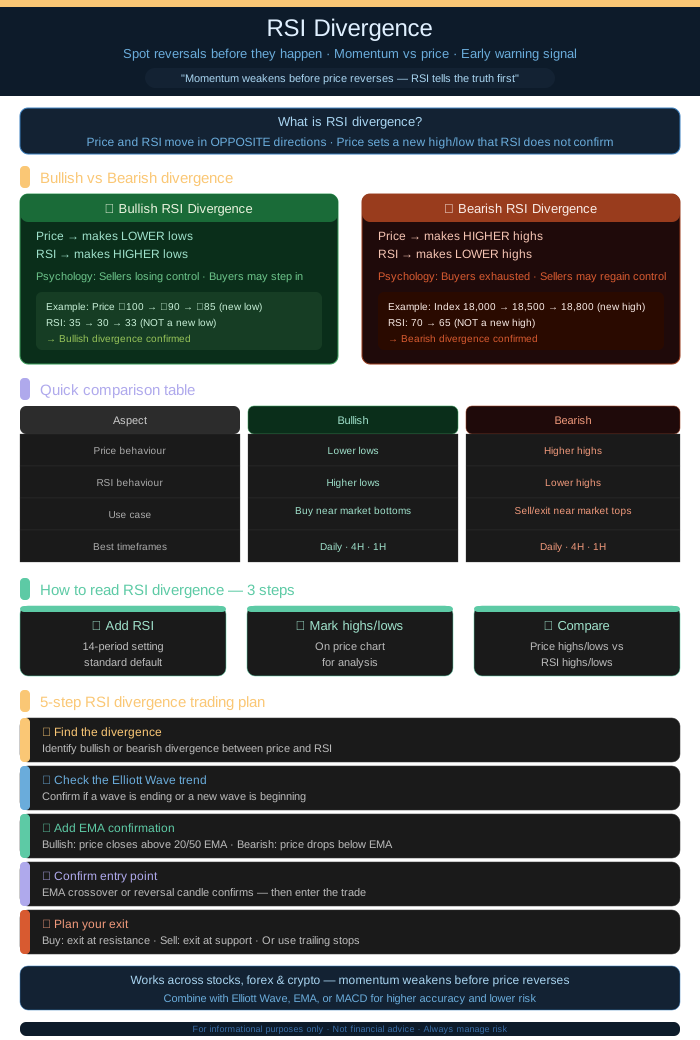
How to Read RSI Divergence?
Reading the RSI divergence indicator is straightforward, but accuracy is essential.
- Add the RSI indicator to your price chart. The RSI indicator is typically set to a 14-period.
- Mark the price highs and lows on the chart for analysis.
- Compare the price highs and lows with the corresponding RSI highs and lows.
- Bearish divergence happens when the price makes higher highs but the RSI makes lower highs.
- As the RSI indicates higher lows, the price forms lower lows. This is known as bullish divergence.
Traders who use the RSI divergence indicator for intraday trading are able to use it on charts that have a five-minute timeframe. This indicator can be used on both daily and weekly charts and is utilized for the purpose of planning long-term trades.
RSI Divergence Trading
| Aspect | Bullish RSI Divergence | Bearish RSI Divergence |
|---|---|---|
| Price Behavior | Price makes lower lows | Price makes higher highs |
| RSI Behavior | RSI makes higher lows | RSI makes lower highs |
| Psychology | Sellers are losing control; buyers may step in | Buyers are exhausted; sellers may regain control |
| Best Time Frames | Daily, 4-hour, or 1-hour charts for higher accuracy | Daily, 4-hour, or 1-hour charts |
| Typical Use Case | Identifying buy opportunities near market bottoms | Identifying sell or exit opportunities near market tops |
| Why It Works | Momentum weakens before price reverses | Momentum loss warns of an upcoming correction |
RSI Divergence Trading Strategy
Here’s how you can turn the concept of RSI divergence into a practical trading strategy.
You can use Elliott Wave, EMA, or even MACD confirmation to generate precise entry and exit signals once you have identified a divergence in the market. Your trading strategy will become more accurate and contain less risk as a result of this combination.
Step-by-Step RSI Divergence Trading Plan
- Find RSI Divergence: Look for divergence between price and RSI that is either bullish or bearish.
- Check the Trend: You can use Elliott Wave to see if the market is ending a wave or getting ready to begin a new one.
- Add EMA Confirmation:
- For bullish divergence, wait for the price to close above either the 20 EMA or the 50 EMA.
- For bearish divergence, wait for the price to drop below the EMA.
- Entry Point:
- If the exponential moving average (EMA) crosses over or if a reversal candle confirms bullish divergence, this could indicate a potential buying opportunity.
- Whenever a bearish divergence coincides with an EMA crossover or the conclusion of an Elliott wave, it is a good time to sell.
- Exit Strategy:
- For buy positions, exit at the next significant resistance level; for sell positions, exit at the closest support level.
- As an alternative, you can use trailing stops to protect your profits.
Example:
Imagine identifying a bullish RSI divergence on a 4-hour chart of Nifty50. In this case, the price forms lower lows while the RSI generates higher lows, indicating a possible Wave 2 bottom in line with Elliott wave theory. When the price crosses above the 20 EMA, that marks your entry point. Once the reversal is confirmed, you can ride the next impulsive wave upward—a setup characterized by high probability and low risk! Read more…
This approach is effective across various markets—such as stocks, forex, or cryptocurrencies—because RSI divergence indicates that momentum is weakening prior to a potential change.
Final Thought
If you want to predict market reversals before they occur, mastering RSI divergence is one of the most valuable skills you can develop. It acts as an integrated early warning system for momentum changes.
By learning to identify bullish and bearish RSI divergence, you’ll gain insight into when buyers or sellers are starting to lose control of the market. You can enhance the effectiveness of your RSI trading strategy by incorporating this information alongside tools such as Elliott Wave, EMA, or MACD.
Therefore, the next time, pay attention to what the RSI is showing rather than just the price. Once you begin to recognize RSI divergence signals, your perspective on the market will change dramatically.
FAQ
What is the best RSI setting for divergence?
Most traders find that 14 periods is the best setting for RSI because it strikes a good balance between sensitivity and reliability. With shorter settings like 7 or 9 RSI, signals come in faster but may be noisy. On the other hand, with longer settings like 21 RSI, fluctuations are smoothed out for long-term analysis. If you prefer scalping, choose a short-term RSI period. Choose a long time frame if you enjoy swing or position trading.
How do you confirm RSI divergence signals?
You shouldn't only use RSI to look for signals of RSI divergence. Look at more than one technical indicator and watch how the price moves. The RSI should not back up clear price highs or lows. Traders should look for these. They should then look for confirmation from areas of support and resistance, breaks in trendlines, volume growth, or candlestick patterns that show a turnaround. Using longer-term charts (like daily or weekly ones) along with RSI divergence and tools like Elliott Wave structure or moving averages makes the signals more trustworthy, helping you spot likely market reversals early.
Disclaimer
This post is just meant to provide you information; it is not financial advice. Trading and investing are risky, and results from the past don’t always mean results in the future. People who want to invest or trade should do their research and think about their situation before making a decision. This content’s author and platform are not responsible for any damages or losses that happen because of its use. Get personalized help from a qualified financial expert.


I have been surfing online more than 3 hours today yet I never found any interesting article like yours It is pretty worth enough for me In my opinion if all web owners and bloggers made good content as you did the web will be much more useful than ever before
Magnificent beat I would like to apprentice while you amend your site how can i subscribe for a blog web site The account helped me a acceptable deal I had been a little bit acquainted of this your broadcast offered bright clear idea