




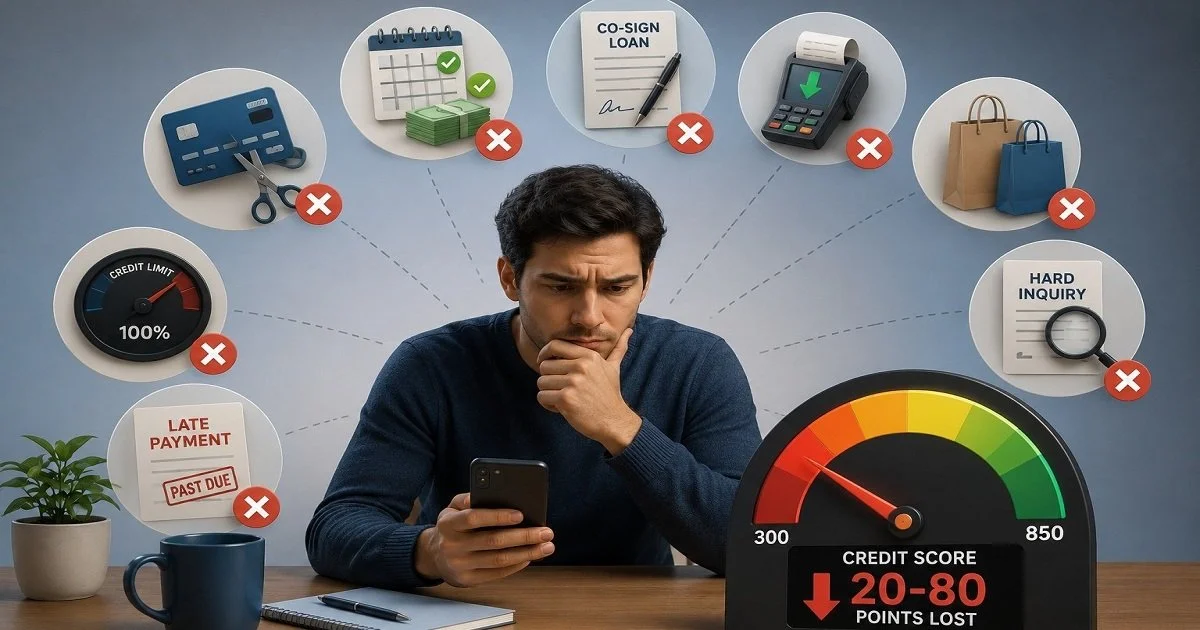
Here are 7 mistakes that can significantly harm your credit score. Making minimum payments will also increase your credit utilization, which can take 1-2 billing cycles to lower. Late payments can cost you 50 to 150+ points on your score, and it can take 3-7 years to recover. Closing your account with an issuer can cause your score to drop 10 to 30 points, and it can take you 6 to 12 months to bounce back. Some patterns repeat. This action can lead to a drop of 30 to 80 points within one to three months. These kinds of mistakes can hurt your score and take a while to fix, so keep your credit habits in excellent shape.
When you make any of the seven mistakes in this guide, they don’t seem like mistakes at all. Closing a card you don’t use seems responsible. When you pay off your balance right after getting paid, it feels like you’re being disciplined. You co-sign a loan for a family member. Sounds like a good thing to do. Both are completely rational, well-intentioned decisions—and both can silently cost you 20-80 points on your credit score, usually without warning when it happens.
Quick reference: all seven mistakes at a glance
Each mistake below is explored in full, but here is the complete picture if you want the summary first.
| Mistake | Score Impact | Time to Recover | |
| 1 | Closing old credit cards | 20–60 points | 6–18 months |
| 2 | Maxing out before payday | 30–80 points | 1–3 months (fast fix, easy to repeat) |
| 3 | Applying for multiple cards at once | 20–40 points | 6–12 months |
| 4 | Paying only the minimum repeatedly | Indirect, utilization stays high | 1–2 cycles once fixed |
| 5 | Co-signing or guaranteeing a loan carelessly | 50–150+ points if the other party defaults | 3–7 years |
| 6 | Ignoring your statement for errors and fraud | Variable — can be severe if unresolved | Depends on dispute resolution time |
| 7 | Letting a card go inactive without a plan | 10–30 points (issuer-closed account) | 6–12 months |
| 1 |
Closing Old Credit Cards |
HIGH IMPACT |
Closing a credit card that you no longer use seems like beneficial financial hygiene. Fewer accounts, less clutter, and one less thing to keep track of. It is, in fact, one of the most reliably damaging things you can do to your credit score. And it’s doubly damaging to two different scoring factors at once.
| What Happens | Why It Hurts | The Fix |
| Available credit drops immediately when the card closes | Utilization ratio rises on remaining cards, 30% of your score | Keep old cards open, even with minimal use |
| Average account age recalculates lower | Length of credit history, 15% of your score, takes a hit | If a fee is the concern, ask for a downgrade to a no-fee version instead of closing |
| The closed account eventually drops off your report entirely | You lose that account’s age contribution permanently after ~10 years | Make one small purchase every 2–3 months to keep the card active and prevent issuer-side closure |
The exception that proves the rule
If the card has a high annual fee that you don’t want to pay, and the issuer doesn’t offer a free downgrade option, then closing the card may be a beneficial decision even with the score hit. The ongoing fee might not be worth the benefit to your score of keeping the card open. But it’s a conscious tradeoff, not an automatic reflex on every unused card.
| 2 |
Maxing Out Before Payday |
HIGH IMPACT |
Maxing out your credit card and paying it off in full as soon as your salary comes in is considered financially responsible; you always pay off the balance and never incur interest. What’s the problem? But the credit bureaus don’t see your payment; they see the balance reported on your statement date, which is before your payday payment clears.
| Behaviour Pattern | Reported Utilization | Score Impact |
| Spends close to the limit, pays in full right after payday | High (statement date snapshot is taken BEFORE the payment) | Significant utilization was counted regardless of later payment |
| Spends moderately, pays in full before statement date | Low to moderate | Minimal to positive |
| Makes a mid-cycle payment before the statement generates | Reduced, reflects the lower balance | Improved — even without changing total spending |
This error is one of the most common and fixable mistakes in this entire list because the adjustment requires no change in total spending, only a change in timing. Paying down your balance even a few days before your statement date, rather than waiting until after it generates, can meaningfully lower your reported utilization without spending one rupee less over the month.
| 3 |
Applying for Multiple Cards at Once |
HIGH IMPACT |
Each credit card application generates a hard inquiry, a record visible to every lender who checks your file afterward. A single inquiry is a minor, recoverable event, costing 5 to 10 points that fade within 6 to 12 months. The mistake isn’t applying for a card; it’s applying for several in a short window, which compounds in a way that isn’t simply additive.
Three or more hard inquiries within 60 to 90 days don’t just stack three separate 5- to 10-point deductions; they create a pattern that bureaus and lenders interpret as a signal of financial distress, independent of your actual reasons for applying. This interpretation can trigger manual underwriting review or outright decline on subsequent applications, meaning you absorb the inquiry’s score cost without even receiving the card.
The fix
Space credit applications at least 3 to 6 months apart. If you’re comparing offers, use each issuer’s soft pre-qualification tool first; these do not generate hard inquiries and let you check your approval odds before committing to a formal application.
| 4 |
Paying Only the Minimum, Repeatedly |
MODERATE IMPACT |
Paying the minimum on time technically counts as an on-time payment; it does not directly damage your payment history, the largest single factor in your score. But making such payments your standard pattern, month after month, keeps a revolving balance permanently on your account, which keeps your utilization elevated indefinitely.
The indirect damage compounds with the direct financial cost: you’re paying 30% to 42% APR in interest every month while simultaneously suppressing your score through chronically high utilization. Neither cost is visible in the moment you choose to pay only the minimum; both show up gradually on your statement and your credit report, respectively.
This mistake is covered in complete detail, with the full payoff math, in our dedicated guide on what happens if you only pay the minimum—but the short version is to treat the minimum as an emergency floor, never a default monthly choice.
| 5 |
Co-Signing or Guaranteeing a Loan Carelessly |
SEVERE IMPACT |
This mistake is the least discussed and potentially the most severe on this list because the damage isn’t caused by anything you did; it’s caused by someone else’s behavior, on an obligation that is legally and fully yours regardless.
| Scenario | What You’re Actually Agreeing To | Real-World Consequence |
| Co-signing a personal loan for a family member | Equal legal responsibility for the FULL loan amount if they default | Missed payments appear on YOUR credit report, not just theirs |
| Adding someone as an authorized user on your card | Their spending behaviour can affect your utilization and payment history | Their high spending or missed payment drags your score down even though you didn’t make the charges |
| Guaranteeing a friend’s business loan | Full liability for the loan if the business fails | Can result in collections action and severe score damage with little warning |
The rule that protects you
Before you co-sign, guarantee, or add anyone as an authorized user, ask yourself one question: If this person stops paying entirely, starting next month, can I absorb the full payment myself without damage? If the answer is no, then the relationship value of helping them does not outweigh the real, serious, and long-lasting credit risk you are taking on. This is not a matter to be decided on account of social obligation.
| 6 |
Ignoring Your Statement for Errors and Fraud |
MODERATE-SEVERE IMPACT |
Most cardholders see the total due on their statement and move on. The least informative number on the page is the grand total owed. The line-item detail, not the summary total, holds the secrets to catching problems early, fraud, billing errors, and incorrect interest charges.
| What to Check Every Statement | Why It Matters |
| Do you recognize all transactions? | Unrecognised charges may indicate fraud or a compromised card number |
| The minimum payment and total due. Do the numbers match your tracking? | Billing errors do happen; catching them early avoids late fees over a disputed amount |
| Any new fees you don’t understand | Unexplained fees should be queried with the issuer before they’re allowed to compound |
| Does the interest charged, if any, match your expectations based on your payment behavior? | A surprise interest charge can indicate a missed grace period or a payment processing delay |
A quick fraud charge is a quick dispute with no long-term consequences. Unnoticed charges for two billing cycles can impact your credit utilization, lead to late payments if they exceed your limit, and complicate resolution due to established patterns of inactivity. It only takes minutes each month to review each line item but is worth far more than the time it takes to unravel a problem found late.
| 7 |
Letting a Card Go Inactive Without a Plan |
MODERATE IMPACT |
This mistake is the quieter cousin to Mistake 1. You don’t close the card; you just stop using it, thinking you’ll keep it open for the credit history benefit. The problem is that many issuers close accounts automatically after 12 to 24 months of complete inactivity as a matter of routine risk-management practice, and you have no visibility until it’s too late.
However, you still experience all the downsides of Mistake 1, such as having less available credit and a lower average account age, even though you did not make a conscious decision to incur these consequences. (The account is closed by the issuer, not by you.) The card you were “keeping open for your credit score” silently disappears, and you usually find out the hard way, checking your credit report or trying to use the card and getting it declined.
The fix
Buy something small on each card you want to keep open at least once every 2 to 3 months (a subscription payment or a single grocery run is fine). It’s just to create activity on the account before the issuer’s inactivity threshold is reached if you want to pay it off right away.
Final Thoughts
None of the 7 errors in this guide currently appear to be present. Closing an unused card and paying off your balance quickly, as well as helping a family member with a loan, are both important actions to consider. Consider helping a family member by providing them with a loan. Paying the minimum during a tight month is a sensible and well-meaning decision, but it can hurt your credit score. Sensible and well-meaning decisions can still hurt your credit score. You can fix most of these mistakes by slightly changing a habit. Try to keep old cards active as little as possible. Pay off balances before the billing date. Space out applying. Examine your statement carefully and consider the implications before assuming someone else’s credit risk. None of these require more income, discipline, or sacrifice; they only require awareness of the mechanism, which is why a guide like this is worth reading before you make the mistake.