





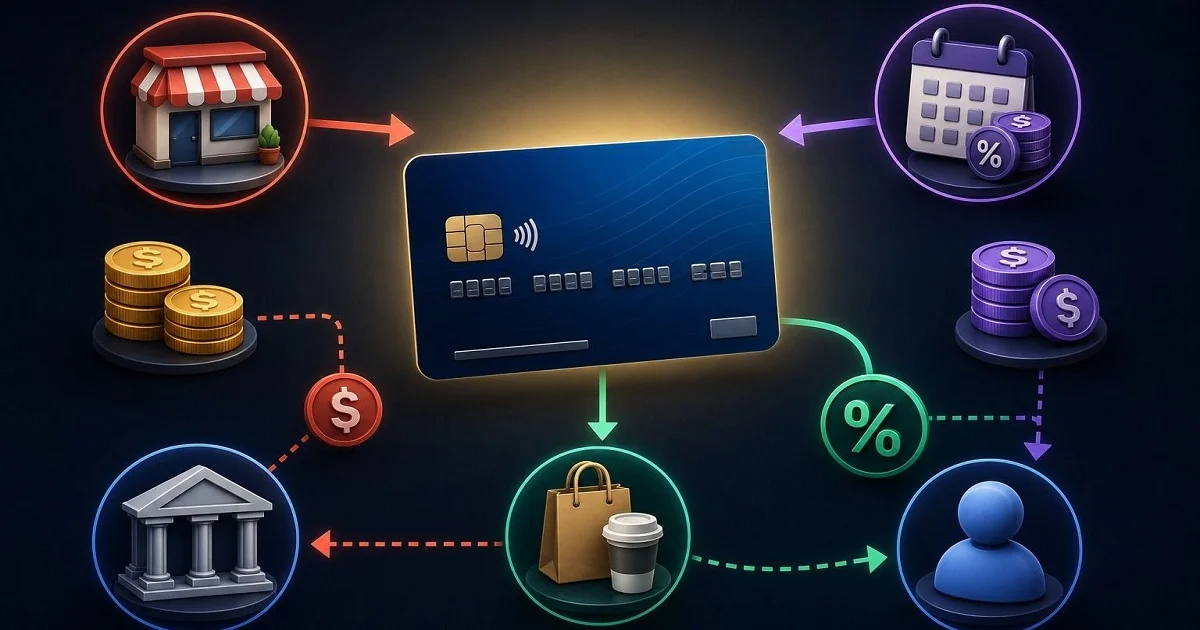
A credit card that pays you 2% cashback for spending money feels almost too generous to question. The bank gives you a card, you use it normally, and money comes back to you—where, exactly, is the catch?
Credit card companies make money primarily from two sources: a fee charged to merchants on every transaction (interchange) and interest charged to cardholders who carry a balance. Rewards are funded largely by these two sources, which means your ‘free’ cashback is, in practice, a partial rebate of money that comes from a specific source.
The Six Ways Credit Card Companies Actually Make Money
Card issuers profit through several distinct revenue streams, only some of which are visible to the cardholder directly:
| Revenue Stream | Who Pays It | Typical Rate / Amount | Visible to the Cardholder? |
| Interchange fees | The merchant, on every transaction | 1%–3% of transaction value | No—built into retail prices, not itemised to you |
| Interest (finance charges) | Cardholders who carry a balance | 30%–42% APR | Yes—but often underweighted relative to its actual cost |
| Annual and joining fees | All cardholders on fee-bearing cards | Rs. 0–25,000+ per year | Yes—clearly stated |
| Late payment and over-limit fees | Cardholders who miss a payment or limit | Rs. 100–1,300+ | Yes—but easy to forget exists until triggered |
| Cash advance fees | Cardholders withdrawing cash on credit | 2.5%–3.5% + immediate interest | Yes—but the immediate-interest detail is often missed |
| Foreign transaction markup | Cardholders spending in foreign currency | 1.5%–3.5% | Partially buried in the conversion, not a separate line |
The two biggest and most stable sources of revenue, interchange fees and interest income, are also the two that operate the furthest from the cardholder’s direct line of sight. The bank and the merchant exchange information in a manner that is completely invisible to you. The interest might look small on your statement, but the real size of it, compounded over months, is something even careful card users frequently underestimate.
Interchange Fees: The Invisible Engine
Interchange is the fee your bank pays the merchant’s financial institution every time you buy something—it’s typically 1% to 3% of the transaction value, set by the card network (Visa, Mastercard, or RuPay), and negotiated between banks and not visible to you at the point of sale.
| Step | What Happens | Who Benefits |
| 1 | You pay Rs. 1,000 at a shop using your credit card | — |
| 2 | The merchant’s bank deducts an interchange fee (e.g., 2%) before settling the rest to the merchant | Your card’s issuing bank receives this fee |
| 3 | The merchant receives roughly Rs. 980, not the full Rs. 1,000 | The merchant absorbs the cost |
| 4 | The merchant, like most businesses, factors this cost into its general pricing across all customers | All shoppers—cash and card alike—share this cost via prices |
| 5 | Your bank funds part of your 1.5% cashback from the interchange fee it just collected | You receive a portion of the fee back as a reward |
Why it matters, even if you never carry a balance
Even a cardholder who pays every statement in full, never pays a rupee in interest, and never incurs a single fee is still generating a real, ongoing profit for their issuer—every single time they swipe the card. Interchange is the part of the business model that exists regardless of your personal repayment behavior, which is precisely why it’s the least visible and least discussed.
Interest Income: The Bigger and More Volatile Source
Interest, charged at 30% to 42% APR on any balance carried past the due date, is the single largest profit driver for most card issuers, and it is significantly larger than interchange for banks with a meaningful share of revolving balances.
The structural reason interest is so profitable: the minimum payment is deliberately calculated to extend repayment over a long period, during which ordinary interest accrues on a shrinking but still substantial balance for months or years. A cardholder who pays only the minimum on a meaningful balance can generate multiples of the original purchase amount in interest over the full repayment period, which we cover in detail in our guide on what happens if you only pay the minimum.
This type of interest is also the most cardholder-controllable revenue source on this entire list: a cardholder who pays the full statement balance every month generates zero interest income for their issuer, regardless of how much they spend.
So Where Do Your Rewards Actually Originate?
If interchange and interest are the two largest profit sources, your cashback or points are funded, directly or indirectly, from a blend of both—and from a slightly uncomfortable crossover most cardholders never think about.
| Funding Source | Approximate Share of Reward Funding | What This Means for You |
| Interchange fees from your own spending | Significant—directly tied to how much you spend | Higher spend funds higher rewards in a fairly direct loop |
| Interest paid by OTHER cardholders who carry a balance | Significant issuers cross-subsidise rewards using interest income from revolving cardholders | If you always pay in full, you may be a net beneficiary of others’ interest payments |
| Annual fees on the same card | Meaningful on fee-bearing premium cards specifically | You are partly funding your own rewards through the fee you already pay |
| Prices paid by ALL shoppers, including those without cards | Indirect, but real—interchange costs are baked into general retail pricing | Cash-paying shoppers subsidise card rewards without receiving any of the benefit |
The uncomfortable cross-subsidy, stated plainly
If you pay your card in full every month and earn rewards doing so, a meaningful part of the funding for those rewards likely comes from interest paid by other cardholders who carry a balance. You are not doing anything wrong by benefiting from this arrangement, but it’s worth knowing that the ‘free’ rewards system is, in part, funded by people in a more financially stressful position than you are. This doesn’t make rewards undesirable to use; it just makes the word ‘free’ worth questioning.
Which Cardholders Are Actually Profitable to the Bank
Not every cardholder is equally valuable to an issuer—and understanding which profile you fall into is genuinely useful context for understanding your relationship with your card.
| Cardholder Type | Primary Profit Source for the Bank | Is This Cardholder Profitable? |
| Pays in full every month, spends moderately | Interchange fees on their spending only | Modestly profitable, but far less than the next category |
| Pays in full every month, spends heavily | Interchange fees on a large spend volume | Profitable, high transaction volume offsets the lack of interest income |
| Carries a revolving balance regularly | Interest income, often regardless of spend level | Highly profitable, interest income typically exceeds interchange by a wide margin |
| Pays in full, spends minimally, rarely uses the card | Little to none, beyond any annual fee | Often unprofitable, the issuer may not actively want this customer, or may seek to close inactive accounts |
The counterintuitive insight here is that the cardholder who carries a revolving balance is, from the bank’s perspective, the most profitable customer by a wide margin. This phenomenon is part of why so much of the credit card industry‘s promotional efforts, including reward programs and limit increases, are structured in ways that make carrying a balance slightly easier to fall into, even when no individual feature is designed maliciously.
Reframing ‘Free’ Rewards Honestly
None of this means rewards are a trick or that you shouldn’t use them—a cardholder who pays in full and earns 1.5% to 2% cashback on planned spending is making a genuinely good financial decision, extracting real value from a system that exists regardless of their participation. But the marketing language around rewards is worth translating into more accurate terms:
| The Marketing Says | What’s More Accurate |
| ‘Free’ cashback or points for spending | A partial rebate of a fee the merchant already paid, funded by retail prices that all shoppers, including cash payers, help cover |
| Rewards as a pure bonus with no cost to you | Rewards exist because issuers profit elsewhere, primarily interest income from cardholders who carry balances, and share a slice of that profit to keep you engaged |
| A high reward rate means a great deal | A high reward rate is sustainable for the issuer only if enough of their customer base generates profit elsewhere, often through interest from a different cohort of cardholders |
What This Understanding Actually Changes for You
Knowing how the system works doesn’t mean avoiding credit cards—it means using them with a clearer picture of where the value comes from and where the risk sits:
- Paying in full every month is the one decision that determines whether you’re on the profitable side or the bank’s side.
- A high reward rate on a card with a high annual fee is not automatically a beneficial deal—it’s a deal that depends on whether your spending and repayment pattern generates enough value to outweigh the fee, independent of any cross-subsidy from other cardholders.
- Interchange fees are a real cost embedded in retail prices for everyone, including people who never use a credit card—a useful piece of context for thinking about the broader economics of card payments, beyond your card specifically.
- A ‘free’ welcome bonus or rewards program is sustainable for the issuer only because enough of its overall customer base generates interest income elsewhere—this is not evidence that the issuer is operating at a loss to win your business.
Final Thought
Merchants pay a fee on every transaction, and cardholders pay interest on a monthly balance. Reward programs are funded with a mix of both, so the cashback or points you earn are real money. A disciplined cardholder who pays in full can get real and consistent value from this system without giving up rewards or feeling cheated. It simply means understanding that “free” rewards are funded by merchant fees, prices all shoppers pay, and interest other cardholders pay. The single decision most likely to put you on the winning side of that arrangement is the same as nearly every guide in this series: pay your statement in full every month.
FAQ
What's the biggest way credit card companies make money?
Interest charges. If you carry a balance month to month, you're charged interest—often 20% or higher APR—on the unpaid amount. Because interest compounds, a balance that isn't paid off can grow quickly, making such fees the single largest revenue source for most issuers.
Do annual fees actually matter to the company's bottom line?
They add up, but they're usually smaller than interest and interchange revenue. The annual fees are more of a filter for cardholders who will spend a lot (which makes sense for rich rewards) and pay for the cost of premium perks like lounge access or travel credits.
Why do card companies offer cash back and travel points if it costs them money?
Rewards are a customer-acquisition and spending-incentive tool. Card companies profit enough from interchange fees and interest that they can afford to return a slice of it as rewards—while also encouraging you to spend more on that card instead of a competitor's.
Are late fees and penalty APRs a major profit driver?
They're a meaningful but secondary source. Late fees are typically capped by regulation, and penalty APRs (which can spike after a missed payment) mostly just increase the "interest charges" bucket. They matter more as a behavioral lever—reminding you to pay on time—than as a standalone profit center.


interesting