





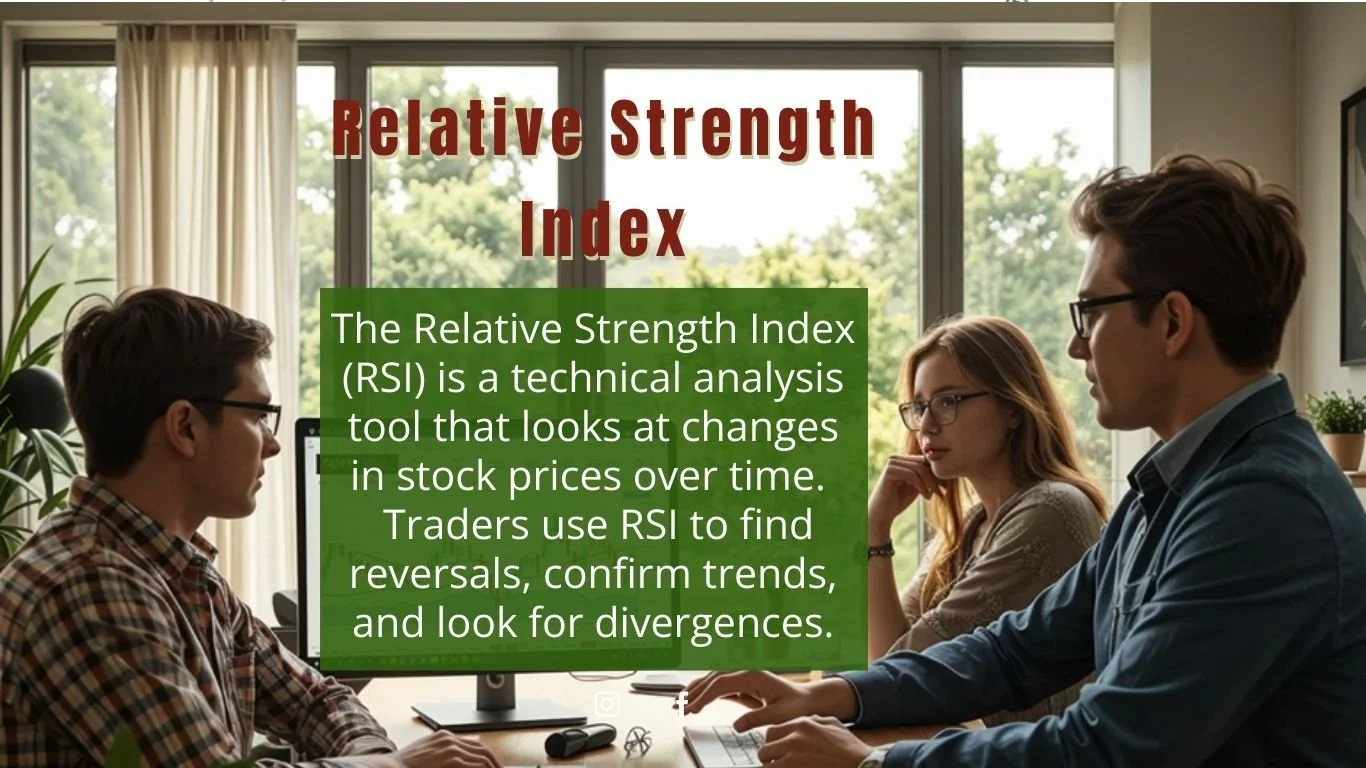
RSI, or Relative Strength Index, is a momentum indicator used in technical analysis to evaluate stock price movements. It helps determine if an asset is overbought (above 70) or oversold (below 30). The calculation compares the average gains and average losses over a specified period, usually set at 14 days. Traders can use the RSI to identify potential reversals in price movement, confirm existing trends, and detect divergences between the indicator and the asset’s price.
If you’ve ever looked at a stock chart and wondered how traders know when things are going to change, you need to learn about the RSI indicator. The Relative Strength Index, or RSI, is one of the most powerful technical analysis tools for measuring momentum.
You can use the RSI indicator to see how strong or weak a stock’s price movement has been lately. In simple terms, it tells you if the stock is too high (overbought) and likely to fall soon, or too low (oversold) and likely to rise soon.
What Is the RSI Indicator?
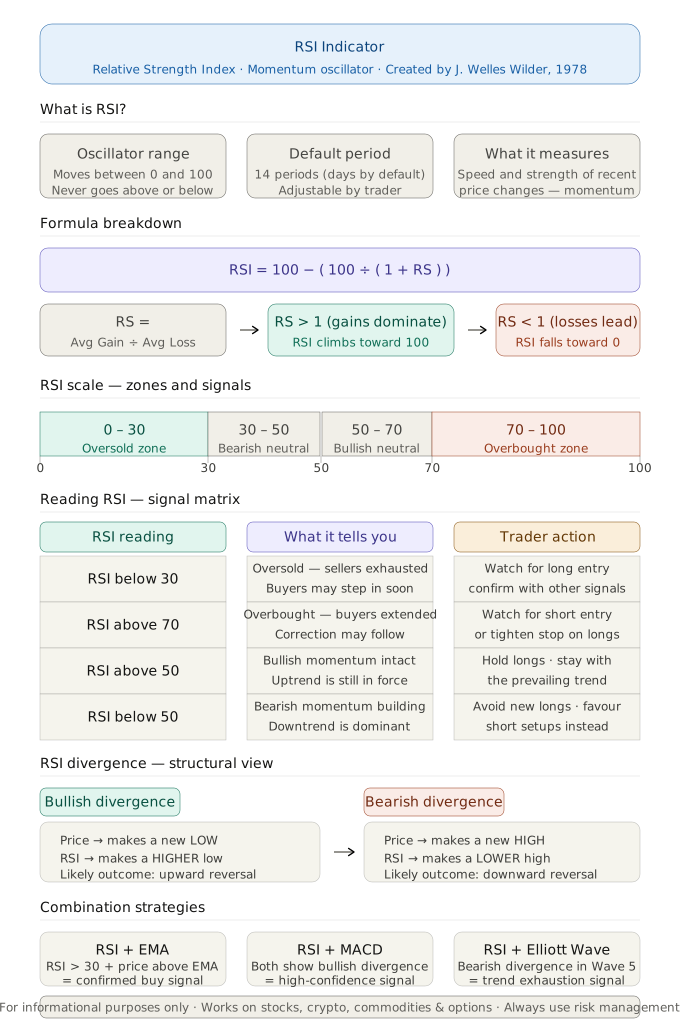
J. Welles Wilder made the RSI in 1978. It is a momentum oscillator that moves between 0 and 100. Most traders think that 70 is too high and 30 is too low.
- If the RSI is above 70, the asset may be overbought, and a correction could happen.
- If the RSI drops below 30, it could mean that the asset has been sold too much and could bounce back soon.
In short, the RSI tells you when to buy or sell based on how strong or weak the market is.
How Is the RSI Indicator Calculated?
Knowing how the RSI is calculated can boost your confidence in the numbers you see.
The RSI formula is
RSI=100−100/1+RS
Where RS (Relative Strength) = (Average Gain over 14 periods) ÷ (Average Loss over 14 periods).
So, RSI looks at the average price changes (both gains and losses) over a certain time, which is usually 14 days.
- When gains are bigger than losses, the RSI goes up.
- When losses are more frequent than gains, the RSI declines.
If you watch a stock for 14 days and see that it closes higher most days, your RSI will probably be above 50, which means that the stock is going up.
What Is RSI in Stocks?
Let’s put it into action now. When you use the RSI indicator on stocks, it shows you whether a stock is worth more or less than it is based on how its price has changed recently.
If you see that the RSI value for Reliance Industries drops below 30, that’s a sign that the stock might bounce back. It means that the sellers are exhausted and buyers might come in soon.
On the other hand, if RSI goes above 70, it means that the stock is too expensive in the short term, which could be a good time to sell.
So, keep in mind that it’s a momentum meter that lets you know when prices have gone too far in either direction.
How to Use the RSI Indicator?
If you’re curious about how to use the RSI indicator, your approach will depend on your trading style. Here are some effective ways to utilize it:
1. Identify reversals
You can use RSI to find out when a stock is likely to change direction.
- RSI less than 30 means the stock is oversold and may bounce back soon.
- If the RSI is above 70, the stock is overbought and may soon go down.
2. Confirm trends
RSI can also tell you if a trend is getting stronger or weaker.
- When RSI stays above 50 during an uptrend, it shows that bullish momentum is still going strong.
- When RSI stays below 50, it shows that bearishness is strong.
3. Find divergences
RSI divergence is when the price and RSI move in opposite directions. This is a strong signal that the trend is about to change.
How to Read the RSI Indicator?
Let’s explore how to read the RSI indicator using real chart examples for easier application.
Example 1: RSI in Oversold Zone

In April 2020, crude oil (USOIL) fell to all-time lows, and the RSI fell below 20. This very oversold zone showed that sellers were in complete control. Shortly thereafter, the market experienced a significant upward movement.
You could have made a huge profit if you had noticed the RSI value and its divergence—when the RSI rose while the price fell.
Example 2: RSI in Overbought Zone
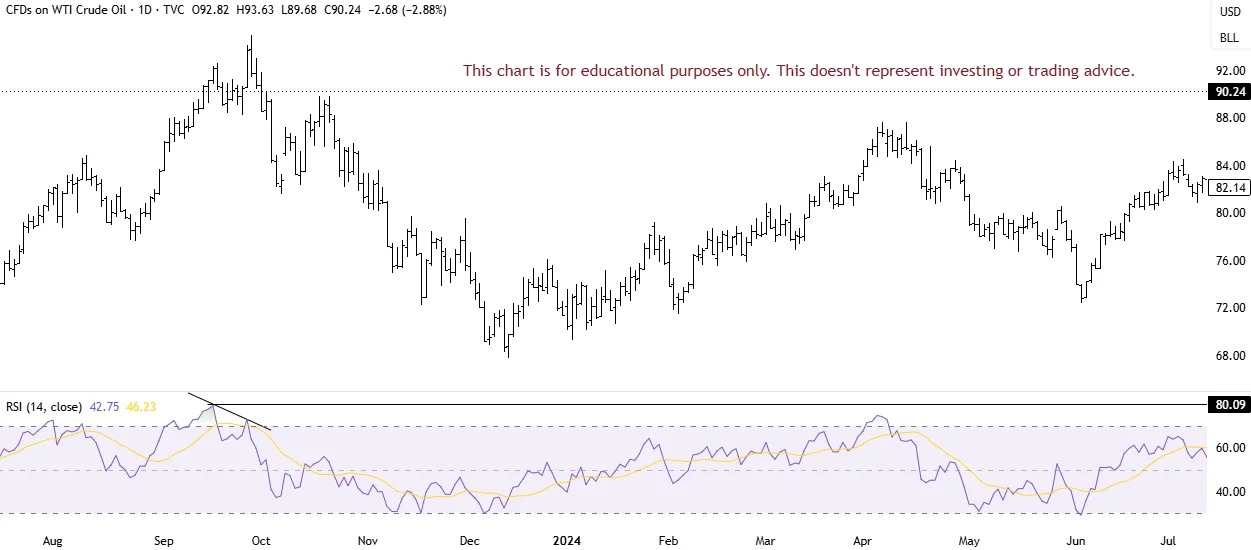
The USOIL RSI went above 80 in September 2023, which meant that it was overbought. The price rose one last time, but the RSI began to move in the opposite direction, which is a classic sign of bearish divergence.
The market went back down within days, which confirmed the RSI warning.
This illustration shows how reading RSI can help you avoid buying at the top and selling at the bottom.
Trading With the RSI
When you use the RSI indicator with other tools, it becomes more powerful for trading.
RSI and EMA crossover
A strong buy signal happens when the RSI goes above 30 and the price goes above the 20 EMA.
If the RSI goes below 70 and the price goes below the EMA, it’s time to sell.
RSI and MACD divergence
If RSI shows bullish divergence and MACD crossover happens at the same time, you have two signs that an uptrend is coming.
RSI works on all assets
You can use RSI on charts for stocks, cryptocurrencies, commodities, and even option premiums. The logic is still the same: it’s all about measuring momentum.
RSI also helps find wave exhaustion in Elliott Wave analysis. For instance, RSI often shows bearish divergence during Wave 5, which confirms that a bullish impulse has ended.
Final Thoughts
Understanding RSI and how it works shows why it’s one of the most trusted technical indicators in trading. It helps you predict changes, confirm trends, and avoid emotional decisions.
When you learn how to read the RSI indicator in the real market, you can see the hidden strength and weakness behind every price change.
The next time you open your chart, don’t just look at the candles. Pay attention to how RSI changes. When you combine RSI with tools like MACD or EMA, you can see a clear path that tells you when to enter, when to leave, and when to wait.
FAQ
Is RSI 100% accurate?
This type of trading truly demonstrates the proficiency of skilled traders. RSI serves as a tool to validate your existing knowledge, not a panacea.
RSI, like the weather report for price momentum, is generally accurate, but its accuracy is not guaranteed. Prices can stay too high or too low for a long time, which can lead to false signals during strong trends.
Support and resistance, trendlines, and moving averages are some of the other tools that you should use with RSI. When you confirm RSI signals with price action, your accuracy increases significantly.
How to confirm RSI signals?
To use RSI well, you need to confirm your findings. Don't just act on every sign of overbought or oversold; seek evidence to back up your decisions. Like a pro, here's how to check RSI signals:
- Check the price structure: Look for double tops or bottoms or breakouts that match the RSI reversal zones.
- Watch for divergence: If the price goes up but the RSI doesn't, that's a sign that momentum is slowing down.
- Use more than one time frame: Check the RSI setup on higher time frames to get stronger signals.
- Add trend confirmation: Use moving averages or MACD to make sure you're trading with the bigger trend, not against it.
When you use RSI with price action confirmation, you get rid of noise and only see the setups that are most likely to work.
What is the 70/30 trading strategy?
One of the easiest and most effective ways to trade momentum reversals is the 70/30 RSI trading strategy. This is how it works:
- When the RSI surpasses 70, traders consider the stock overbought, indicating potential exhaustion among buyers. When RSI falls below 70 again, traders often look for a chance to sell.
- Traders perceive the stock as oversold when the RSI drops below 30, suggesting a potential exhaustion among sellers. When the RSI goes back above 30, traders look for a sign to buy.
Using momentum as your guide, it's a classic "buy low, sell high" strategy. But the best traders don't just use RSI; they also check the trend direction, support and resistance, and volume to make sure they don't get false signals.
Disclaimer
This post is just meant to give you information; it is not financial advice. Trading and investing are risky, and results from the past don’t always mean results in the future. People who want to invest or trade should do their research and think about their situation before making a decision. This content’s author and platform are not responsible for any damages or losses that happen because of its use. Get personalized help from a qualified financial expert.


