




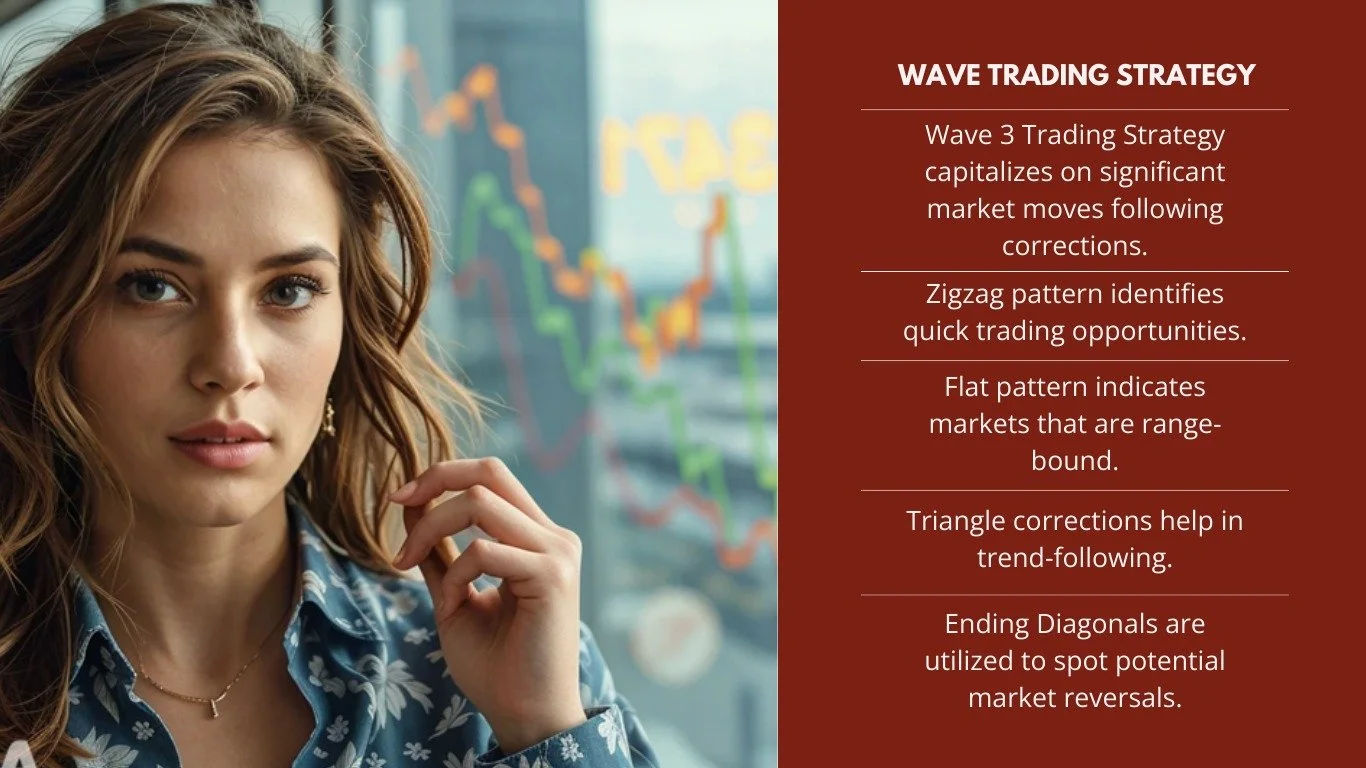
The wave trading strategy helps traders figure out what the market will do and make the best trades in different types of assets. The Wave 3 Trading Strategy helps you take advantage of strong moves after corrections. The zigzag pattern helps you find quick opportunities. The flat pattern helps you find markets that are stuck in a range. The Triangle Corrections help you follow trends, and the Ending Diagonals help you find possible reversals. All of these need accurate wave counts and confirmations.
What Is Wave Trading?
If you’ve ever wanted to know the secret to predicting market reversals, you’re about to learn it—the wave trading strategy. Ralph Nelson Elliott established this effective trading strategy on the premise that investor psychology drives the recurrence of market cycles.
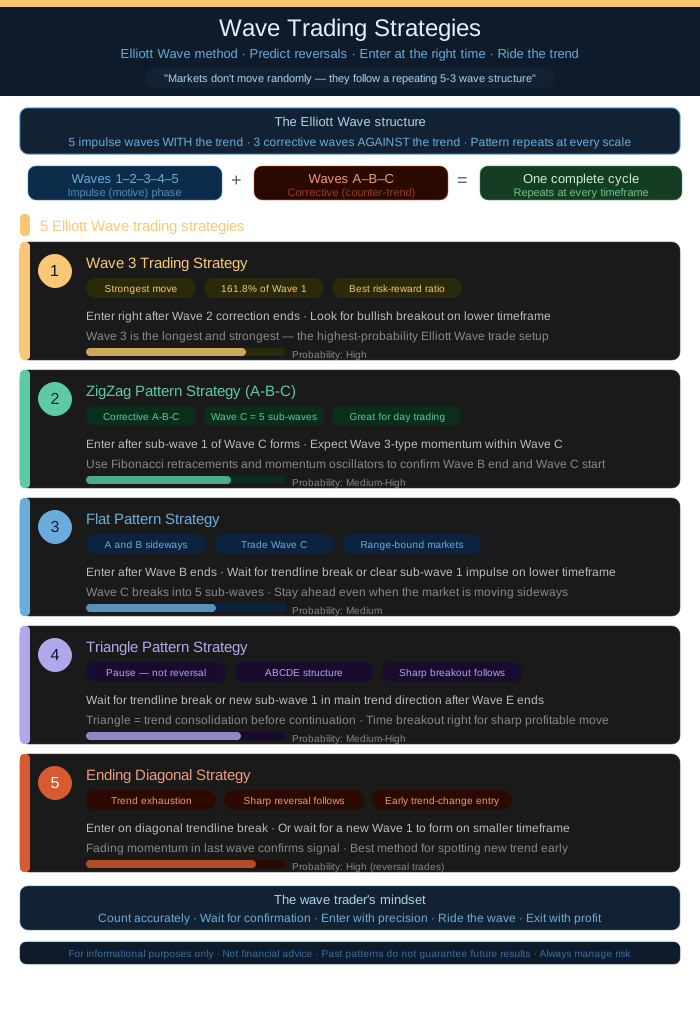
When you start using Elliott Wave trading, you’ll see that the market doesn’t move randomly. Instead, they follow a clear pattern: five waves that go with the main trend (called impulse waves) and three waves that go against it (called corrections).
If you trade Elliott Waves, you can use this structure to determine the market cycle and prepare for the next big move. Knowing Elliott Wave can give you a big advantage whether you trade stocks, forex, or cryptocurrencies.
In short, the Elliott Wave strategy helps you predict the next wave so you can enter trades at the right time, ride the trend with confidence, and leave with the most money.
Elliott Wave Trading Strategies
Let’s now look more closely at some of the best Elliott Wave trading strategies. These setups aren’t just ideas; they’re patterns that professional wave traders use every day in the real world.
If you can accurately count the waves and wait for confirmation, each of these wave trading strategies will give you a high-probability setup. Let’s go through them one by one.
1. Wave 3 Trading Strategy
After every correction, a new motive wave begins. On a smaller scale, you’ll first see a Wave 1 start to form. After Wave 2 finishes its correction, Wave 3 will start. This is the longest and strongest move in the Elliott Wave structure.
In real trading, you can enter right after Wave 2 ends, preferably when you see a bullish breakout on the lower time frame. This setup often goes along with strong momentum signals. This entry has a great risk-to-reward ratio because Wave 3 is usually 161.8% of Wave 1.
The Wave 3 trading strategy is one of the best ways to find a high-probability Elliott Wave trade.
2. ZigZag Pattern Trading Strategy
Wave C usually has five sub-waves in a zigzag correction (A-B-C pattern). You can get ready to enter the trade once the first sub-wave of Wave C (sub-wave 1) forms. You should expect a strong Wave 3-type move within Wave C.
This setup lets you take advantage of short-term chances during the correction if you are a wave trader. This strategy is great for day trading Elliott Wave because it focuses on smaller but still strong moves.
You can also use advanced Elliott Wave analysis tools like Fibonacci retracements or momentum oscillators to find the end of Wave B and the start of Wave C to confirm your entry. Read more…
3. Flat Pattern Trading Strategy
When there is a flat correction, waves A and B often move sideways, and wave C is what you need to trade. Wave C, like the ZigZag, also breaks down into five smaller waves. The first sign of a possible trend continuation is the formation of sub-wave 1.
This setup is a fantastic place to enter the market after Wave B ends if you are using an Elliott Wave strategy for range-bound markets. Before you enter, wait for confirmation, like a break in the trendline or a clear impulse on the smaller time frame.
This EW trading strategy keeps you ahead, even when the market is going sideways. Read more…
4. Triangle Patterns and Next Move
A triangle correction means that the trend has stopped, not that it has changed direction. The market is taking a break before moving in the same direction again.
When trading triangles, you should wait for the trendline to break or for a new sub-wave 1 to form in the same direction as the main trend. This is a crucial sign for you to enter.
As an Elliott Wave trader, your goal is to catch that last push, which is often seen in triangles before the last wave of a move. If you time it right, the breakout after a triangle can be sharp and make you money. Read more…
5. Ending Diagonals and Next Move
After an ending diagonal, there is usually a sharp change in direction. That means the price is getting ready to move in the opposite direction for a long time.
You can trade right away if the trendline of the diagonal breaks, or you can wait for a new Wave 1 to form on a smaller scale to make sure. Some traders also enter at the end of the diagonal’s last move if they see that momentum is running out.
This is one of the best Elliott Wave methods for spotting trend changes and getting in on new trends early. Read more…
Final Thoughts
Before making a trade, it’s always important to see Wave 1 on a smaller scale. Before you take a position, ask yourself, “Can I clearly see Wave 1 forming on the lower time frame?”
That one simple question can help you avoid false signals and make your accuracy much better.
The Elliott Wave trading strategy isn’t just about counting waves; it’s also about knowing how people think in the market. You can predict moves more accurately and consistently when you time your trades with these natural market cycles.
So, whether you’re new to Elliott Wave trading or have been doing it for a while, learning these setups can help you make better, more profitable trades in any asset class.
FAQ
What is the accuracy of the Elliott Wave Theory?
How well you understand the wave structure determines how accurate Elliott Wave Theory is.
If you use confirmation tools like Fibonacci retracements, RSI, or MACD divergence correctly, they can tell you which way the market is going and when it will turn back 70–80% of the time.
But keep in mind that this is not a tool for making predictions; it is a framework for probabilities. To trade Elliott Waves, you need to know how the market thinks and where you are in the cycle.
Your accuracy will naturally get better once you learn the different wave personalities, such as the explosive Wave 3 or the sneaky Wave B. The more you watch, the more accurate your wave counts get.
How to trade Elliott Wave like a pro?
To trade the Elliott Wave strategy like a pro, you need to know more than just how to count waves. Here are the steps you need to take:
Step 1: Figure out the bigger trend. Use longer time frames, like daily or weekly, to see where the market is in its big wave, whether it's a motive or a correction.
Step 2: Check the subwaves.. To check for smaller wave patterns inside the main trend, switch to a shorter time frame. This is when the timing of the entry becomes exact.
Step 3: Use tools based on Fibonacci. Use retracements and extensions to figure out where each wave might start or end. For example, Wave 3 often goes up to 161.8% of Wave 1.
Step 4: Trade with the wave's personality.
Wave 1: Getting in early and not being sure of yourself.
Wave 3 has the strongest momentum, making it the best for trend trading.
Wave 5: Last push—take your profits.
Wave A-B-C: Look for setups that show reversals or corrections.
Step 5: Use stop-loss wisely. Put the stops past the end of the last wave. This will keep you safe from fake breakouts.
When you stick to this strict plan, you don't just trade the market; you also understand it. That's how professional Elliott Wave traders always stay ahead of the game.
Disclaimer
This post is just meant to give you information; it is not financial advice. Trading and investing are risky, and results from the past don’t always mean results in the future. People who want to invest or trade should do their research and think about their situation before making a decision. This content’s author and platform are not responsible for any damages or losses that happen because of its use. Get personalized help from a qualified financial expert.

Satyajit Baidya
An option writer who came to the markets through curiosity and stayed through conviction. He studies price action through the lens of Elliott Wave theory and draws his trading philosophy from Jesse Livermore—the belief that discipline, timing, and patience matter more than predictions do. A student of history by training, he sees the market as just another chapter in a very long story: the details change, the patterns don’t.