





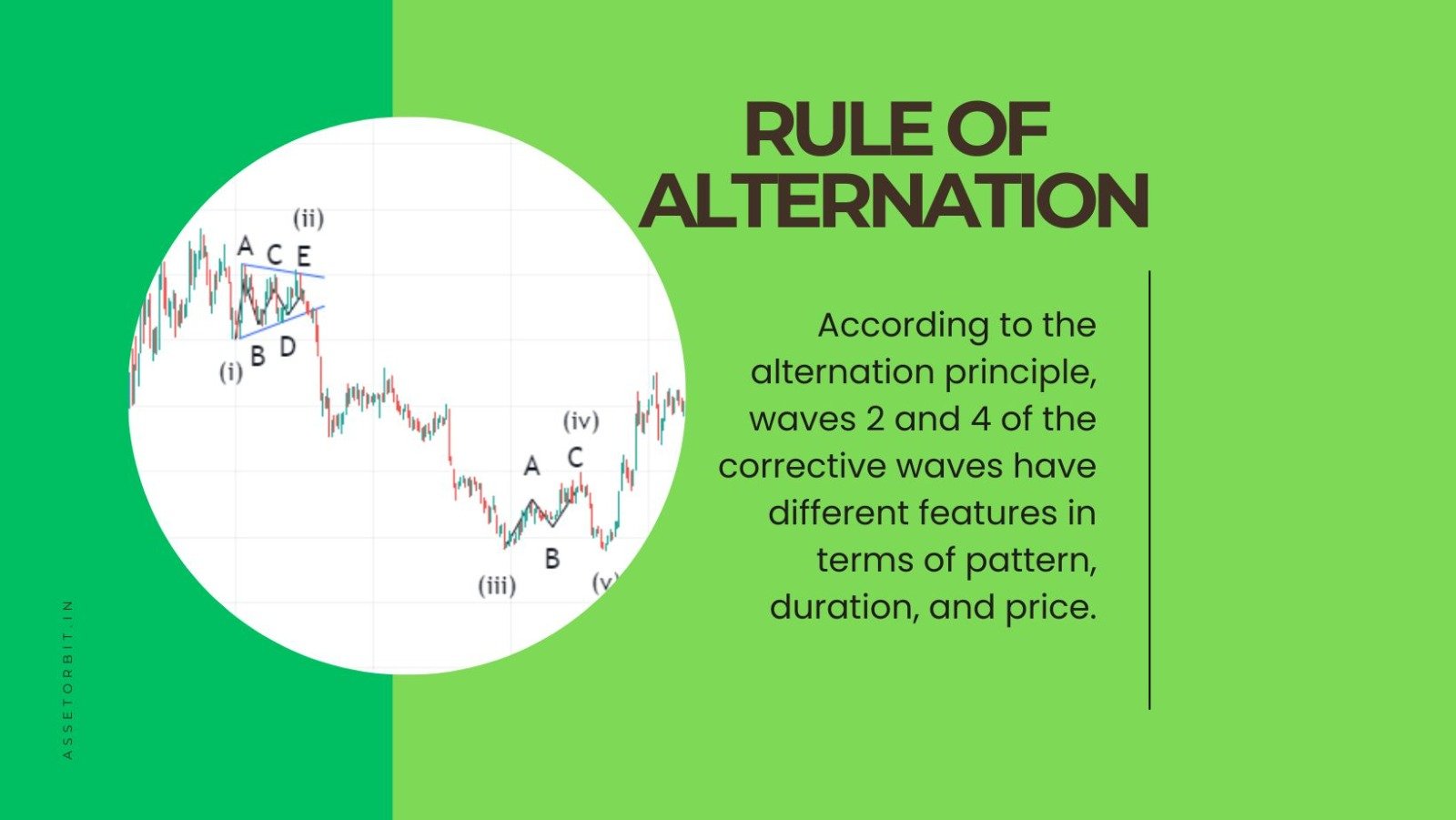
Alternation in Elliott Wave theory is the hidden nature of its patterns, consisting of two corrective waves, Wave 2 and Wave 4. Wave 2 is a straightforward correction, while Wave 4 is more complex. Recognizing alternations helps traders make smart entry decisions and clarify corrections, allowing them to predict and adapt to market changes.
Alternation in the Elliott Wave
The term “alternation” in the Elliott Wave refers to the hidden nature of its patterns. Alternation consists mostly of two corrective waves, Wave 2 and Wave 4.
Have you ever noticed?
Observing alternations becomes apparent quickly. Look at the chart once more. Within the same sequence, you will note that two subsequent corrective waves do not unfold in the same way. Based on the area covered in terms of pattern, duration, and pricing, the two waves have different characteristics.

Rule of Alternation
In Elliott Wave Theory, alternation refers to the idea that corrective waves, particularly Waves 2 and 4, have opposing characteristics.
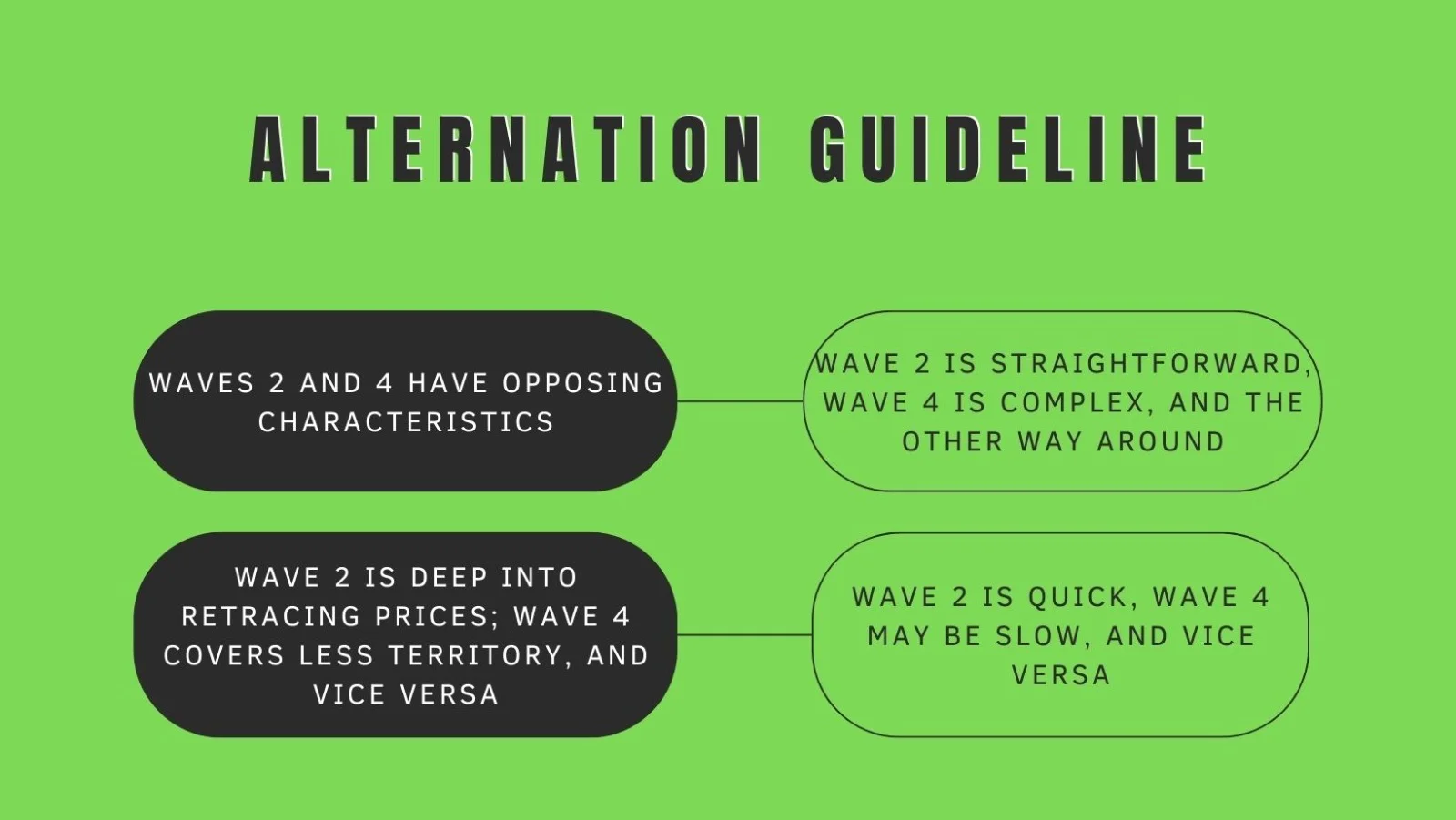
If Wave 2 is a straightforward correction, Wave 4 will most likely be more complex, and vice versa.
Consider it as a delicate equilibrium. If Wave 2 goes deep into retracing prices, Wave 4 will most likely cover less territory.
On the other side, if Wave 2 is a short correction, Wave 4 may cover a wider price range.
Timing is also important; if Wave 2 is slow, Wave 4 may be quick, and vice versa. This alternation principle enables traders to forecast and adjust to changing market patterns.
Why the Rule of Alternation Matters in Elliott Wave Analysis?
Elliott Wave Theory’s Rule of Alternation helps traders predict corrective waves. Choose when to enter the market to reduce risk. If traders want to make the most of market moves in a certain direction, they need to know how Waves 2 and 4 change in terms of time, structure, and depth. They will be able to better guess Waves 3 and 5 now.
This principle is especially powerful when combined with Fibonacci retracement levels, price action analysis, and volume confirmation, making it a critical concept for advanced Elliott Wave practitioners.
Key Takeaways for Traders (Rule of Alternation Strategy)
| Scenario | Expected Outcome | Action Plan |
|---|---|---|
| Wave 2 Deep (50–61.8%) |
Wave 4 is likely shallow (38% of wave 3 or less) |
Prepare for a strong Wave 5 continuation |
| Wave 2 Shallow (38% or less) |
Wave 4 may be complex and broader |
Be patient; wait for pattern confirmation |
| Wave 2 Zigzag |
Wave 4 is probably triangular, flat, or complex. |
Identify structure shift early |
| Wave 2 Fast |
Wave 4 is likely slower |
Adjust holding time expectations |
| Wave 2 Slow |
Wave 4 is likely quick |
Plan quicker entries for wave 5 |
Wave 2: Characteristics, Patterns, and Rules
The Elliott Wave theory’s Wave 2 is frequently used as a warning to traders because it indicates that the market is getting ready for significant moves after this correction phase has been completed. Many professionals like to get into the market during this time of correction, when the wave count is correct.
The correction’s duration varies, but it normally falls within a 50% retracement of Wave 1. During this phase, zigzags and flats are the most common patterns.
Traders enter based on either the natural pattern or a Fibonacci retracement of 61% to 78%. It is important to understand that Wave 2 will never exceed Wave 1’s beginning position. This insight sets it apart from the preceding waves, especially Wave 2 in sequence.
How Much Does Wave 2 Retrace?
Wave 2 retraces a significant portion of Wave 1, usually around 50% but varying from 38.2% to 61.8%. This retracement is viewed as a corrective measure preceding the next significant price movement.
It’s crucial to keep in mind that the precise percentage may change and that the context and specific market circumstances can have an impact on how much of a retracement an asset or instrument experiences. Here, traders often use Fibonacci retracement levels to pinpoint probable reversal points.
Elliott Wave theory’s idea that after each corrective phase, a motive phase begins is crucial to traders and investors. To prepare for the next motive wave, one must identify the corrective waves. Read more…
Rule of Wave 4 Retracement
Wave 4 usually retraces 38 to 50 percent of Wave 3. During this stage, complex corrections are frequently observed. Moreover, Wave 4 continues to alternate with Wave 2. This rule gives an explanation of the likely characteristics of Wave 4 in relation to Wave 2.
If Wave 2 was zigzag, Wave 4 might fix things in a different way, in a way that is flat, triangular, or complex. It is important to note that this guideline takes into account not only patterns but also time duration and price distance to provide a full analysis of potential Wave 4 movements.
How Far Can Wave 4 Retrace?
Have you ever looked at a chart from afar and seen a complicated correction in a market that was moving in a certain direction? For a while, the price may fluctuate within a specific range.
This intricate adjustment frequently obscures Wave 4. Recognizing this complexity makes recognizing Wave 4 easier, especially when calculating the proportion with respect to Wave 3. In such circumstances, Wave 4 may retrace 38–50% of Wave 3, signifying a probable retracement zone.
Rule of Alternation in Elliott Wave: A Comparison of Wave 2 and Wave 4
| Feature | Wave 2 Correction | Wave 4 Correction | Trading Insight |
|---|---|---|---|
| Basic Principle |
First corrective wave after Wave 1 |
Second corrective wave after Wave 3 |
Understanding both improves Elliott Wave forecasting accuracy |
| Rule of Alternation |
If deep, Wave 4 will likely be shallow |
If shallow, Wave 4 may be broader |
Expect contrast in structure and depth between Wave 2 and 4 |
| Retracement Level (Fibonacci) |
Typically retraces 38.2%–61.8% of Wave 1 (50% common) |
Usually retraces 38%–50% of Wave 3 |
Use the Fibonacci retracement tool to identify potential reversal zones |
| Depth of Correction |
Often deeper compared to Wave 4 |
Generally shallower if Wave 2 was deep |
Helps in setting stop-loss and entry levels |
| Structure Type |
Usually simple (zigzag pattern common) |
Often complex (flat, triangle, or combination patterns) |
Pattern recognition improves trade timing |
| Speed & Time Duration |
If slow and prolonged, expect Wave 4 to be quicker |
If there is a quick correction in wave 2, wave 4 may take a longer time |
Time alternation helps anticipate market behavior |
| Price Territory Rule |
Cannot retrace beyond the start of Wave 1 |
Should not overlap Wave 1 in impulse waves |
Confirms wave count validity |
| Market Psychology |
Profit-taking after initial impulse |
Consolidation after strong Wave 3 momentum |
Reflects crowd psychology shift |
| Role in Trend Continuation |
Prepares market for strong wave 3 |
Prepares market for final wave 5 move |
Major profit opportunities lie after corrections |
Massive gains start with a motive wave. Long price rallies serve as indicators of motive waves. Recognizing and riding motive waves can boost trading profits. Read more…
Final Thought
Finally, the concept of alternation can be used to better understand market corrections. The corrections follow motive waves; recognizing alternations helps traders make intelligent entry decisions. Smoother entries and better navigating through market volatility are made possible by alteration, which also makes corrections more clear and leads to a more strategic and successful trading approach.
FAQ
Can wave 2 be a flat?
Yes, Wave 2 might look like a flat correction. There are three waves that show flat corrections, which are A, B, and C. Wave 2 can form as a flat with three sub-waves: an initial downward wave (A), a corrective upward wave (B), and another downward wave (C) in an uptrend. This correction happens after the first impulsive Wave 1. Based on the Elliott Wave theory, this shows the variety of corrective patterns that Wave 2 could show.
Can wave 2 go below wave 1?
Having something like this happen is not a valid count for Wave 2. Wave 2 can't go below Wave 1's level or above Wave 1's peak if it goes up. Traders can use this rule to find and confirm exact wave counts within the market trend while still using Elliott wave analysis.
Disclaimer
This article does not offer you financial advice; it is merely informational. Trading and investing are risky, and results from the past don’t always mean the same thing will happen in the future. Before making investment decisions, readers should conduct their research and consider their individual circumstances. The author and platform are not responsible for any financial losses or damages resulting from the use of this information. Get personalized advice from a trained financial counselor.

Satyajit Baidya
He is an option writer who came to the markets through curiosity and stayed through conviction. He studies price action through the lens of Elliott Wave theory and draws his trading philosophy from Jesse Livermore—the belief that discipline, timing, and patience matter more than predictions do. A student of history by training, he sees the market as just another chapter in a very long story: the details change, the patterns don’t.


